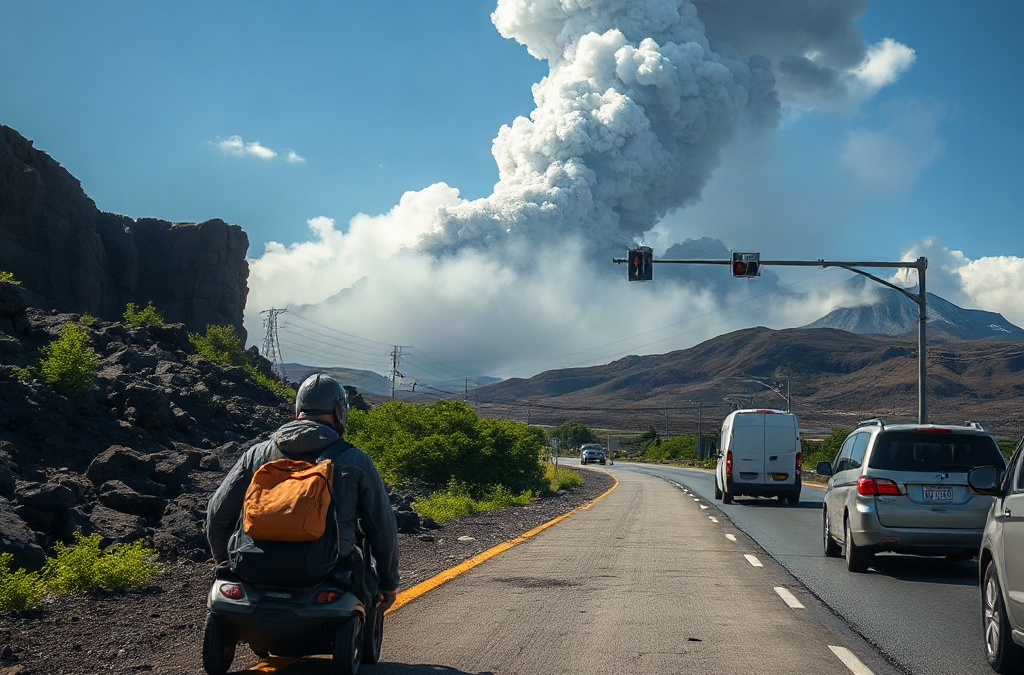
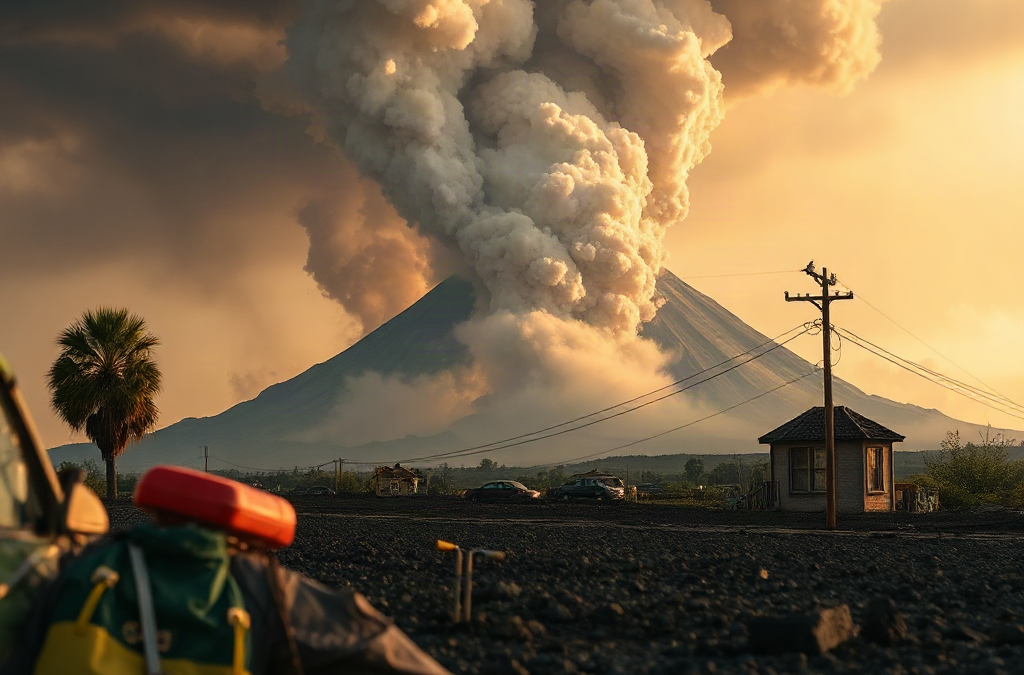
Evacuation readiness begins with location-specific information, not a generic emergency kit. A volcano may produce ashfall, lava flows, pyroclastic flows, debris avalanches, volcanic gases, or lahars—mudflows that can travel along river channels and drainages, sometimes well beyond the visible eruption area. Local emergency managers and geological agencies map these hazards differently, so a home that is outside a lava-flow zone may still be exposed to ash or a lahar route.
Find the official volcano hazard map for your community and mark your home, workplace, school, childcare location, regular travel routes, and the places where family members spend evenings. Note whether each location sits near a stream, canyon, bridge, coastline, or low-lying valley. A route that looks short on a phone may cross a channel that authorities could close first. Save an offline copy because cellular data and electricity may be unreliable during an evacuation.
Two routes are more useful than a single favorite route, but they should not simply be two versions of the same road. Choose alternatives that separate from one another early and lead away from designated hazard zones. If a bridge is the only crossing, identify a safe meeting location on both sides rather than assuming everyone can travel together.
Record the official evacuation zones and the agency that issues orders.
Identify routes that avoid river channels, narrow valleys, and known closures.
Choose an out-of-area meeting place and a contact outside the immediate region.
Ask schools, employers, and care providers how they release or relocate people.
A common mistake is treating a familiar road as automatically safe. During ashfall, visibility can drop, road surfaces may become slippery, and traffic can stop at bottlenecks. A second mistake is relying on a map without checking its date or the instructions attached to it. Review official maps and alert subscriptions periodically, especially after moving, changing jobs, or adding a new school or care obligation. The Volcano eruption preparedness for evacuation readiness process becomes much more workable when the geography is understood before an alert creates pressure.
Turn Alerts Into an Evacuation Decision
Official alerts should determine when you act; personal observation should not. Volcanic activity may escalate before residents see a dramatic plume, and hazards such as lahars can arrive with little useful warning in areas downstream. Subscribe to local emergency notifications, understand the difference between an advisory and an evacuation order, and keep a battery-powered or hand-crank way to receive information if internet service fails.
Write down the action associated with each alert level used by your local authorities. For one household, an advisory may mean checking fuel, medications, and animal transport. A warning may mean loading the vehicle and moving vulnerable people early. An evacuation order means leaving by the designated route rather than waiting to see whether conditions appear dangerous. Follow local instructions if they conflict with a preselected route, because authorities may close roads or redirect traffic based on changing conditions.
Timing involves a real tradeoff. Leaving too early may mean waiting elsewhere, missing work, or using fuel and lodging resources sooner than expected. Leaving too late can place a family in traffic, expose people to ash, and make it harder to assist someone who needs extra time. People who use oxygen, powered medical equipment, wheelchairs, or regular refrigerated medicines should build more time into the decision because their departure has additional steps.
Use a short departure sequence rather than improvising:
Confirm the instruction through an official source, not an unverified social-media post.
Contact household members and the designated out-of-area contact.
Collect the ready bag, medicines, documents, protective gear, and pet supplies.
Turn off utilities only if local authorities advise it and doing so is safe.
Leave using the assigned route, avoiding closed roads and restricted zones.
Do not create a plan that depends on every family member returning home first. A parent may be at work, a teenager may be at school, and a caregiver may be responsible for another person. Agree on who has authority to leave, where people reunite, and what happens if communication is unavailable. The evacuation readiness plan should make the safest decision obvious when the household is separated.
Pack for Ash, Displacement, and Special Needs
A volcanic evacuation kit should support movement and several days away from home, while remaining light enough to carry. Ash is abrasive rather than ordinary dust; it can irritate eyes and airways, contaminate exposed water, and enter vehicles and buildings. Pack sealed eye protection, suitable respiratory protection recommended by local authorities, durable clothing, closed shoes, gloves, water, shelf-stable food, a flashlight, spare batteries, a first-aid kit, and chargers or battery packs.
Prescription medicines deserve special attention because evacuation delays may outlast a normal daily routine. Keep a current medication list, copies of prescriptions, identification, insurance information, and essential medical instructions in a waterproof pouch. Store supplies for infants, older adults, and people with disabilities in the same grab location, but do not assume a single bag will meet every need. A child may need comfort items; a person with hearing loss may need written alerts; a service animal may require food, identification, and equipment.
Vehicle preparation has limits. A full tank can improve flexibility, but vehicles should not be treated as sealed shelters during heavy ashfall. Ash can reduce visibility, clog filters, and damage engines and moving parts. If authorities direct people to shelter temporarily, keep windows closed and ventilation set to recirculate when appropriate; if they order evacuation, follow the route and driving instructions rather than attempting to outrun visible ash.
Keep household supplies in more than one form. Bottled water is convenient for departure, while stored water at a destination may be useful if evacuation lasts longer. Digital documents are easy to access but fail when batteries or networks fail, so retain paper copies. A compact priority list is more reliable than a huge kit:
Water, ready-to-eat food, medications, and personal hygiene items.
Eye and respiratory protection, sturdy clothing, and footwear.
Identification, cash, keys, chargers, flashlight, and paper contacts.
Pet or livestock instructions, carriers, food, and vaccination records.
The failure mode to avoid is buying protective equipment without learning how to use or fit it. Poorly fitting gear may offer less protection, and improvised coverings are not equivalent to purpose-designed equipment. Check expiration dates, replace consumed medicines and food, and practice collecting the kit in darkness. For more detail, connect these supplies to the broader volcano evacuation checklist rather than storing disconnected items with no assigned purpose.
Rehearse Routes, Transport, and Communication
A plan becomes usable when people can perform it under interruption. Conduct a short household drill: receive a mock alert, collect the bags, secure pets, check the vehicle, and travel to the meeting point without entering a restricted area. The goal is not speed for its own sake. The goal is to expose missing keys, dead batteries, unclear responsibilities, inaccessible carriers, and routes that fail for someone using a wheelchair or walking aid.
Test the plan under different conditions. One rehearsal can begin with everyone at home; another can assume a child is at school and an adult is at work. Ask each person to explain where they would go and whom they would contact. If the household has only one driver, arrange a backup with a neighbor, relative, community service, or local transportation resource before an emergency. Do not assume ride-sharing services, public transit, or fuel stations will operate normally.
Communication plans should use more than one channel. A text message may succeed when voice calls are congested, but it still depends on a charged device and network access. A printed contact card, a designated out-of-area contact, and a rule to avoid unnecessary calls can reduce confusion. Establish a simple message format that states location, condition, destination, and next check-in time.
Rehearsal also reveals competing priorities. Closing windows, protecting equipment, or photographing damage may feel urgent, but none should delay an evacuation order. Property actions are secondary and should occur only when authorities permit time and conditions are safe. If ash is falling, avoid unnecessary driving and protect air-handling systems only when doing so does not interfere with departure.
After each drill, revise one or two specific weaknesses rather than adding endless equipment. A successful plan has a known trigger, two viable routes, a transport solution for every person and animal, accessible supplies, and a fallback communication method. Repeat the exercise after a move, a medical change, a new pet, or a change in school and workplace arrangements.
Frequently Asked Questions
How early should a household leave during a volcanic eruption?
Leave when local authorities issue an evacuation instruction, or earlier if your household needs extra time for medical equipment, children, animals, or limited mobility. Do not wait for visible lava or ash.
What should go in a volcanic evacuation bag?
Pack water, food, medicines, identification, cash, chargers, a flashlight, first-aid supplies, sturdy clothing, eye protection, respiratory protection recommended by authorities, and needs for pets or dependents.
Why are two evacuation routes useful?
A second route provides an alternative if ash, traffic, flooding, road damage, or an official closure blocks the first. Choose routes that separate early and do not share the same vulnerable bridge or valley.
Should people drive during ashfall?
Follow official instructions. Driving in heavy ash can reduce visibility and damage engines, filters, and moving parts. If evacuation is ordered, leave as directed; otherwise avoid unnecessary travel and wait for guidance.
How can families prepare pets for evacuation?
Keep carriers, leashes, food, water, medicines, identification, and vaccination records ready. Confirm which shelters or accommodations accept animals and arrange a backup driver if the primary driver is unavailable.
Further Reading
Authoritative Sources
USGS Volcano Hazards Program usgs.gov
Provides volcano monitoring, hazard information, and links to regional geological resources
Volcanoes ready.gov
Explains common volcanic hazards and household actions before, during, and after an eruption
Volcanoes and Your Health cdc.gov
Offers health-focused information about ash exposure and protective measures
Conclusion
Effective volcano evacuation readiness is built around decisions made before the alert: know the hazard zones, understand official messages, select independent routes, and assign responsibility for every person, pet, and essential item. A compact kit should protect against ash exposure while supporting medication, communication, and several days away from home. Rehearsals matter because they uncover practical failures that maps and shopping lists cannot reveal, including inaccessible transport, missing keys, and unclear meeting points. Review the plan whenever household circumstances change, and give official evacuation instructions priority over property protection or personal estimates of danger. The next useful step is to download the local hazard map, write down two routes and a meeting place, then test the departure sequence with the people who may need help leaving.
What Scripture Says About Foresight and Preparation
Scripture generally treats thoughtful preparation as compatible with wisdom, responsibility, and care for others. Proverbs 22:3 says that a prudent person sees danger and takes refuge, while the simple continue and suffer the consequences. The verse does not provide a specific supply list; it establishes a decision principle. Recognizing a credible risk and taking proportionate action can be an expression of good judgment rather than a sign of weak faith.
Proverbs 6:6-8 offers a related image through the ant, which gathers provisions in season without needing constant supervision. The practical lesson is consistency. A person who waits until a shortage, storm, illness, or financial setback is already underway has fewer choices and may pay more for rushed solutions. Small, orderly actions taken during stable periods usually create more resilience than dramatic purchases made under pressure.
That principle has limits. Biblical prudence is not the same as trying to eliminate every uncertainty. A modest reserve of water, food, medication, cash, or lighting may address a foreseeable interruption; buying far beyond a household’s ability to rotate, maintain, or share can create waste and anxiety. The useful question is not whether someone has prepared for every imaginable event, but whether their response is proportionate to likely risks and actual responsibilities.
Readers often use Bible verses about preparedness and responsible planning to settle a spiritual concern: does preparing show distrust? The surrounding biblical themes point toward a balanced answer. Trust in God and responsible action are not presented as automatic opposites. Preparation becomes spiritually distorted when fear controls every decision, possessions become a source of identity, or concern for personal security replaces compassion for people in need.
Bible Passages That Connect Planning With Stewardship
Several passages provide distinct angles on responsible planning. Genesis 41 describes Joseph interpreting Pharaoh’s dream and organizing storage during years of abundance so Egypt could face later famine. The account includes forecasting, administration, measurement, labor, and distribution. Its practical value is not a prediction that every reader should build large warehouses. It shows how recognizing a future constraint can lead to an organized response before the constraint becomes acute.
Luke 14:28-30 uses the image of someone calculating the cost of a tower before construction begins. Jesus’ point concerns the seriousness of discipleship, but the example assumes that responsible action includes estimating resources before committing to a project. Applied to ordinary life, that means checking budget, storage space, skill, time, and maintenance requirements before adopting a preparedness goal. A plan that cannot be funded or maintained is only an intention.
Nehemiah 4:9 combines prayer with practical security measures: the people pray and set a guard because of a threat. The passage is useful because it resists two weak assumptions. Prayer is not portrayed as a reason to ignore an identifiable danger, and practical measures are not portrayed as a substitute for dependence on God. A modern parallel might involve praying about a family decision while also confirming emergency contacts, securing important documents, and learning how to shut off utilities.
First Timothy 5:8 emphasizes responsibility toward one’s household, while Acts 2:44-45 and Acts 4:32-35 describe believers sharing resources with people who have need. Read together, these themes complicate an individualistic version of readiness. Caring for dependents requires planning, but surplus is not automatically a private treasure. A household may reasonably prepare for its own needs while reserving capacity to help an elderly neighbor, a church member, or a relative who lacks storage or income.
These passages differ in setting and purpose, so they should not be treated as technical emergency manuals. Their combined guidance is stronger when applied as principles: foresee credible problems, count the cost, organize resources, protect vulnerable people, and keep generosity within the plan.
How to Apply Biblical Wisdom to Household Readiness
Biblical planning becomes useful when it moves from quotation to accountable action. Begin by identifying responsibilities rather than shopping. Who depends on the household? Which medicines, dietary needs, mobility limitations, pets, or communication requirements would make an interruption harder? A plan built around those facts is more valuable than a collection of impressive but unrelated gear.
A simple priority order can prevent scattered spending:
Immediate needs: safe water, ordinary food, essential medication, sanitation, warmth, and a way to receive information.
Continuity needs: copies of key documents, transportation options, charging methods, contact information, and cash access.
People and skills: first-aid knowledge, cooking without normal utilities, neighborhood communication, and agreed responsibilities.
Shared capacity: a realistic way to assist someone who cannot prepare independently.
This order reflects stewardship because it directs limited money and space toward consequences that matter first. For example, a family with a small budget may gain more from rotating familiar shelf-stable foods and keeping prescriptions managed than from purchasing specialized equipment it has never practiced using. The advanced option may be appropriate later, but only after basic needs and operating knowledge are covered.
Planning also needs a review mechanism. Write down what is stored, expiration dates, refill points, and who checks each category. Use ordinary meals to rotate food instead of creating a separate stock that is forgotten. Test flashlights, chargers, cooking methods, and communication plans under safe conditions. Signs that the approach is working include fewer duplicate purchases, clear responsibilities, and supplies that remain usable. Signs of failure include expired items, inaccessible storage, unclear medication arrangements, or a plan known only to one person.
Responsible planning should remain connected to the wider community. The biblical view of preparedness is not limited to private accumulation. Ask whether a church, apartment building, or neighborhood already has resources that can be coordinated. Shared tools, check-in agreements, and knowledge exchange may provide more value than every household buying the same costly item. Coordination also exposes a tradeoff: relying entirely on others is fragile, but refusing cooperation wastes capacity.
Avoiding Fear, Hoarding, and Overconfidence
The main spiritual and practical danger is not preparation itself but disordered preparation. Jesus’ warning in Luke 12:16-21 about the rich fool challenges the assumption that larger reserves guarantee security. The man builds bigger barns and speaks as if stored goods can settle every question of life. The passage does not praise neglect; it questions self-centered accumulation and confidence in possessions.
That distinction matters when preparedness content encourages constant purchasing. Fear can make uncertain scenarios feel inevitable, narrow attention to worst-case images, and turn every sale into an obligation. Hoarding also reduces usefulness: crowded storage makes rotation difficult, poor labeling hides shortages, and excess may spoil before it can help anyone. A smaller, documented reserve that fits the household’s budget can be wiser than a larger stock acquired through debt or panic.
Overconfidence creates a different failure. Someone may own food and equipment yet lack a communication plan, sanitation supplies, medication continuity, or the ability to use the tools. Another person may assume that faith guarantees a particular outcome and therefore reject evacuation advice, medical care, or help from others. Scripture’s emphasis on humility and wise counsel supports checking assumptions rather than treating confidence as evidence.
A practical test is to examine each purchase or decision with four questions: What foreseeable problem does this address? How long will it remain usable? Who knows how to use it? What will we do if another person has a greater need? These questions make preparation measurable without turning it into an obsession. They also help distinguish a useful reserve from symbolic buying that mainly relieves short-term anxiety.
Responsible planning includes accepting uncertainty. A household cannot guarantee safety, predict every event, or control other people’s choices. It can improve its options, reduce avoidable confusion, and respond with greater generosity. For readers comparing Scriptural guidance on planning, the recurring pattern is disciplined action held together with humility, compassion, and trust rather than fear-driven control.
For careful study, read the cited passages in their surrounding chapters and compare several reputable Bible translations. Context matters: Genesis 41, Proverbs 6:6-8, Proverbs 22:3, Luke 12:13-21, Luke 14:28-30, Nehemiah 4:9, First Timothy 5:8, and Acts 2:44-45 address different circumstances. A study Bible or recognized biblical commentary can help distinguish a passage’s original purpose from a modern application.
Frequently Asked Questions
Which Bible verse is most directly associated with preparedness?
Proverbs 22:3 is often cited because it contrasts prudent recognition of danger with careless continuation. Proverbs 6:6-8 and Genesis 41 add examples of gathering resources before scarcity.
Does preparing for emergencies show a lack of faith?
Not necessarily. Scripture can be read as supporting both trust in God and responsible action. Preparation becomes unhealthy when fear, hoarding, or confidence in possessions replaces compassion and humility.
What does Joseph’s example teach about planning?
Joseph’s administration in Genesis 41 illustrates recognizing a future shortage, storing resources during abundance, organizing work, and planning distribution rather than waiting for crisis conditions.
How can Christians prepare without becoming materialistic?
Set reasonable limits based on household needs, budget, storage, and rotation. Include generosity in the plan, and measure success by useful capacity and wise service rather than the size of an inventory.
What should a family do first?
Identify dependents and essential needs, then document contacts, medications, water, food, sanitation, lighting, and communication arrangements. Assign responsibilities and test the plan before adding specialized supplies.
Conclusion
Scripture presents preparedness as a matter of foresight, stewardship, and love expressed through responsible action. Proverbs encourages noticing danger, Joseph demonstrates organized provision before scarcity, and Jesus warns that possessions cannot provide ultimate security. Together, these passages support a measured approach: identify genuine responsibilities, cover basic needs, count the cost, maintain what you store, and include room to help others. Begin with a written household assessment rather than an impulse purchase. Read the relevant passages in context, discuss priorities with the people affected, and review the plan as circumstances change. The goal is not control over an unpredictable future. It is fewer avoidable failures, clearer decisions under pressure, and resources used with humility and care.
Volcanic ash is made of tiny fragments of rock, minerals, and volcanic glass rather than soft household dust. Its effects depend on particle size, wind, moisture, the eruption material, and how long ash remains airborne. A light coating can still irritate the eyes and throat, while heavier deposits may clog ventilation equipment, overload roofs, interfere with vehicles, and reduce visibility on roads.
The first priority is information. Monitor local emergency management, the volcano observatory, weather alerts, and official evacuation notices instead of relying on a single social-media post. Ash may arrive before residents understand its density or direction, and conditions can change when wind shifts. Save alerts on a battery-powered radio or charged phone, and identify at least one contact outside the affected area.
A useful Volcano preparedness checklist for ashfall conditions separates immediate sheltering from later cleanup. During active fallout, the goal is to limit inhalation and prevent ash from entering the building. After the plume clears, the concerns shift toward roof loads, blocked drainage, contaminated surfaces, engine damage, and safe disposal.
Weak assumptions create avoidable problems. Ordinary cloth masks may reduce some larger particles but may not seal well or provide the protection of a properly fitted particulate respirator. A rainstorm does not automatically solve ash buildup; wet ash can become dense and difficult to remove. Likewise, opening windows to “clear the air” may worsen indoor exposure when outdoor ash concentrations remain high.
Respiratory, Eye, and Indoor-Air Protection
Respiratory protection works best when it is available before the plume arrives and worn correctly during exposure. Keep particulate respirators appropriate for fine particles, spare masks, sealed eye protection, and any prescribed respiratory medication in a location that can be reached without searching through contaminated rooms. People with asthma, chronic lung disease, young children, older adults, and anyone with mobility limitations may need a more deliberate sheltering arrangement.
Close windows, doors, fireplace dampers, and other openings when ash is falling. Turn off systems that bring outside air indoors unless the equipment is specifically designed and filtered for the conditions. If a heating or cooling system must operate, inspect its filter instructions and replace filters as directed; a filter loaded with ash can restrict airflow and push particles through gaps. Portable air cleaners may reduce indoor particles in a closed room, but they do not make outdoor exposure safe and require a suitable filter and electricity.
Eye protection deserves separate attention. Contact lenses can trap irritating particles against the eye, so people who wear them should have glasses available. Do not rub ash-covered eyes. Move indoors, rinse with clean water, and seek medical advice for persistent pain, vision changes, or breathing difficulty. Emergency symptoms should not be managed by waiting for the ash to settle.
A practical shelter room is one with few exterior openings, enough space for household members, and access to water, medication, a radio, chargers, and waste bags. Place masks and goggles near the entrance, but avoid leaving them exposed where ash can settle on their inner surfaces. A common mistake is to use a fan that simply redistributes contaminated air; air movement is useful only when it passes through appropriate filtration or safely exhausts air according to official guidance.
Water, Food, Medication, and Power Priorities
Protecting supplies means preventing ash from entering containers rather than trying to clean every exposed item later. Store drinking water in closed, food-safe containers and keep extra water for eye rinsing, basic cleaning, and medication needs. Cover wells, rain-catchment equipment, outdoor taps, and water-treatment components if local authorities advise doing so. Do not assume clear-looking water is suitable for drinking after ash exposure; follow local water utility instructions.
Food in sealed cans, unopened packages, and closed cupboards is generally easier to protect than food kept in open bins or outdoor storage. Wipe the outside of containers before opening them so ash does not fall onto food or utensils. Discard items whose packaging is torn, heavily contaminated, or impossible to clean safely. Ready-to-eat foods are especially useful when ash makes cooking, ventilation, or power uncertain, but a stockpile should still reflect household allergies, infant needs, and medical diets.
Medication planning should account for both supply and access. Refill prescriptions when reasonably possible, keep medicines in closed containers, and include inhalers, glasses, hearing-aid batteries, and other daily-use items. If a pharmacy, clinic, or evacuation route may be inaccessible, ask the relevant clinician or pharmacist about a lawful, safe supply plan rather than changing doses independently.
Power interruptions may follow ashfall because equipment, substations, or access routes become difficult to operate. Charge phones, battery banks, radios, lighting, and medical devices before conditions worsen. Fuel generators only outdoors and well away from doors, windows, and air intakes; ashfall does not remove carbon-monoxide risk. Keep food preparation simple and avoid burning debris or using indoor combustion appliances, since poor ventilation can compound respiratory irritation.
Use a compact priority check before shopping or packing:
Air: particulate masks, goggles, prescribed respiratory supplies, and replacement filters.
Water and food: sealed drinking water, covered supplies, and foods requiring little ventilation or cooking.
Communication: charged devices, a battery radio, spare batteries, and written contacts.
Access: medications, identification, cash or payment alternatives, and supplies for children, pets, and disability-related needs.
The common failure mode is buying cleanup tools while overlooking consumables and prescriptions. A shovel cannot replace water, and a generator cannot compensate for an empty medication container or an unfiltered air intake.
Vehicle Travel, Cleanup, and Recovery Decisions
Driving during ashfall should be treated as a last resort unless officials direct travel or an urgent need requires it. Ash reduces visibility, can make pavement slippery, and may impair engines when drawn through air-intake systems. Vehicles may also become stranded by road closures, fallen debris, or fuel shortages. If travel is unavoidable, follow official route information, use headlights as required, leave more stopping distance, and avoid unnecessary exposure with windows and outside-air ventilation closed.
Vehicle protection is a tradeoff between mobility and damage. Parking under cover can limit deposits, but a garage must not be used for an idling vehicle. If ash enters the engine system, repeated driving may pull abrasive material farther into filters and components. Check the owner’s manual or obtain qualified service advice about air filters, oil, brakes, and other inspection points before resuming normal use. Do not blast ash from surfaces with compressed air near people or open building entrances.
Cleanup should wait for official advice about roof safety, air quality, and waste handling. Dry ash can become airborne when swept, brushed, or blown, while wet ash can be heavy enough to stress roofs and clog gutters. Use appropriate respiratory and eye protection, limit the number of people in the work area, and dampen surfaces lightly when that reduces dust without sending large quantities into drains. Remove ash in manageable amounts rather than creating unstable piles on roofs or balconies.
Prioritize locations where ash creates immediate hazards: entrances and walkways, gutters and drains, air intakes, vehicle ventilation systems, and surfaces used for food or drinking water. Keep children and pets away from ash piles, and clean paws or fur before they track particles indoors. Separate ash from ordinary household waste if local authorities provide special instructions; disposal rules vary by community and by the volume involved.
Do not climb onto a roof simply because it looks coated. A professional assessment may be safer where deposits are deep, wet, uneven, or near damaged structures. The same judgment applies to trees, power lines, and blocked roads. Review the checklist again after each official update, because the appropriate action may change from sheltering to evacuation, inspection, or restricted cleanup.
A Household Ashfall Plan That Can Be Used Under Pressure
A written plan turns scattered supplies into decisions people can follow when visibility, noise, and communication are poor. Assign one person to monitor official alerts, another to check vulnerable household members, and another to secure water, food, and ventilation if staffing permits. Write down meeting places, medication details, pet arrangements, and transport options. Keep a paper copy because phones may lose power or service.
Practice the first ten minutes rather than staging a theatrical drill. Close openings, move to the selected room, put on respiratory and eye protection, bring medication and communication equipment, and account for everyone. If someone cannot use a standard mask because of age, disability, or a medical concern, obtain individualized advice in advance and identify a lower-exposure room or alternate relocation option.
Review the plan for conflicting instructions. A household may need to shelter from ash while remaining ready to evacuate because of lava, lahars, gas, wildfire, or other hazards. Do not delay an official evacuation order to protect possessions or finish sealing windows. Place shoes, outer layers, keys, documents, and pet carriers where they can be reached without crossing heavily contaminated areas.
After the event, note what failed: a mask size, an empty battery, a clogged filter, an inaccessible water container, or an unclear responsibility. Correct that specific weakness rather than buying unrelated equipment. A precise checklist is most valuable when it is tested against the actual rooms, people, vehicles, and local alerts it must serve.
For current ash advisories, evacuation zones, air-quality guidance, water notices, and cleanup instructions, consult the local emergency-management agency, public-health department, volcano observatory, and utility providers serving the affected area. Official instructions should take priority over general preparedness advice because ash characteristics and associated hazards differ by eruption.
Frequently Asked Questions
Should I stay indoors during ashfall?
Usually, yes, when local authorities advise sheltering. Close openings, limit outside-air intake, and leave only for urgent needs or an official evacuation order.
Are cloth masks enough for volcanic ash?
Cloth masks may reduce some larger particles but often provide a poor seal. Use an appropriate, well-fitting particulate respirator when available, and seek medical advice for breathing problems.
Can volcanic ash contaminate drinking water?
It can enter uncovered containers, catchment systems, and some water equipment. Keep supplies covered and follow local utility or health-department instructions before drinking questionable water.
Is it safe to drive while ash is falling?
Avoid driving unless necessary or directed. Reduced visibility, slippery roads, closures, and engine air-filter problems make travel riskier than normal.
How should ash be cleaned from a roof?
Follow local guidance and avoid climbing onto a roof that is wet, heavily coated, damaged, or structurally uncertain. Ash can become heavy when wet, so professional help may be safer.
Conclusion
Ashfall preparation is mainly an exercise in controlling exposure and preserving basic services. Put respiratory and eye protection, sealed water, medications, communication equipment, and replacement filters where they can be reached quickly. During fallout, protect indoor air and avoid unnecessary travel; afterward, treat roof loads, drains, engines, and contaminated surfaces as separate safety problems rather than one large cleanup task. Official alerts matter because ash may arrive alongside evacuation hazards that a household checklist cannot resolve. Test the plan with the people who will actually use it, including children, older adults, pets, and anyone with respiratory or mobility needs. Replace missing supplies, record local contacts, and revise the checklist after each drill or advisory.
The most valuable earthquake poster information is action-based rather than descriptive. Someone reading it during a sudden jolt may have only seconds to respond, so the central instruction should be large, familiar, and visually ordered: Drop, Cover, and Hold On. “Drop” means getting low before the shaking knocks a person down. “Cover” means protecting the head and neck under a sturdy table or desk when one is nearby. “Hold On” means keeping the shelter in place as it moves and staying protected until the shaking stops.
A strong poster explains the sequence without crowding it with paragraphs. Three numbered panels can show a person lowering to the floor, positioning beneath a desk, and gripping a leg while shielding the head. A nearby note should clarify that if no sturdy shelter is close, the person should stay low, move away from windows and falling objects if possible, and cover the head and neck with the arms. The instruction is different for a person already in bed: remain there and protect the head with a pillow unless a clearly safer location is immediately reachable.
Posters often fail when they present “evacuate” as the first response. Running during shaking exposes people to falling ceiling material, glass, furniture, and collisions. Likewise, standing in a doorway is not a universal safety rule; modern doorways may not offer special protection, and the surrounding space may contain falling hazards. The poster should discourage running outside, using elevators, or moving toward windows while the ground is moving.
Keep a related reference such as Earthquake preparedness poster information to include available when reviewing wording, but make the displayed version room-specific and quick to scan. The test is simple: can a visitor identify the first action without reading the entire page?
Room-Specific Hazards and Safe Locations
A poster becomes more useful when it identifies the safest available position in the room instead of relying only on general earthquake slogans. The best location is usually away from windows, mirrors, tall unsecured furniture, hanging objects, and shelves that can spill contents. A sturdy desk or table may provide cover, but a lightweight folding table, glass table, or overloaded surface should not be presented as dependable protection.
Use a small “look around this room” panel beside the main action sequence. It can point to the nearest sturdy table, mark a safer interior area, and identify hazards that should be secured rather than approached. In a bedroom, the illustration may show staying in bed and covering the head, while a kitchen poster should emphasize moving away from cabinets, glass, and appliances when movement allows. In a classroom or office, the design can indicate desks that offer cover and warn against clustering near exit doors.
The tradeoff is between completeness and speed. A detailed floor plan may help staff, but it becomes unreadable if placed on a small public poster. Use one clear room diagram for immediate action and place more detailed furniture-securing or evacuation information in a separate handout. Readers should not mistake a marked “safe spot” for a guarantee: furniture can shift, ceiling components can fall, and conditions vary by building construction.
Include special considerations without turning the poster into a technical manual. A person using a wheelchair or mobility device may need to lock the wheels, remain seated if possible, protect the head and neck, and position away from hazards. Children need pictures and plain verbs. Visitors who do not read English may benefit from universally recognizable illustrations and translated versions. A useful companion link is the earthquake poster checklist, particularly when several rooms need different hazard notes.
What to Add for the Minutes After Shaking
Post-shaking instructions belong on the poster, but they should remain visually secondary to the immediate protective action. After the movement stops, people should expect aftershocks and check themselves and nearby people for injuries when it is safe. The poster can direct readers to put on sturdy footwear, watch for broken glass, and leave damaged areas cautiously if evacuation is required by building conditions or officials.
Specific warnings prevent common secondary injuries. Do not use elevators, touch fallen power lines, or enter visibly damaged structures. If gas is suspected, avoid flames, switches, and other ignition sources and follow local emergency guidance. A poster should not tell untrained occupants to shut off utilities automatically; valve locations, damage, and local procedures differ. A better instruction is to report hazards and follow official or building-manager directions.
Communication guidance also needs restraint. Add the facility address, emergency numbers appropriate to the location, assembly instructions, and the method for receiving official alerts. Avoid printing a long contact tree that becomes obsolete. A short line such as “Text rather than call when networks are congested, if safe and available” may be useful, but it should not distract from injury checks and hazard avoidance.
For example, an apartment poster might direct occupants to check the hallway for damage before leaving and to use the designated assembly area, while a workplace poster may name the floor warden process. Neither should promise that an assembly area is safe under every condition. Conditions must be reassessed after shaking, especially if there are fires, structural damage, chemical spills, or blocked routes. The poster should point people toward official updates rather than encourage rumor sharing.
Design, Placement, and Practice
Readable design is a safety feature. Put the three immediate actions at the top or center, use high contrast, and leave enough empty space around each instruction. Large verbs, numbered steps, and simple figures usually outperform dense prose. Avoid illustrations that show a person crouching beside a table without covering the head and neck, because viewers may copy the incomplete posture.
Place posters where people make decisions: beside desks, in classrooms, near beds or common areas, and close to emergency information boards. Do not hide one behind a cabinet or place it so low that furniture blocks the main message. Outdoor placement can introduce glare and weather damage, while glossy surfaces may be difficult to read under bright lights. Check the poster periodically for faded text, outdated phone numbers, changed room layouts, or procedures that no longer match the building.
Practice exposes weaknesses that printing cannot fix. During a drill, ask participants to identify cover without running, protect their heads, and remain in position until the signal ends. Afterward, note whether desks can actually be reached, whether mobility devices have enough clearance, and whether staff understand what happens next. A poster that says “evacuate” without naming the route or decision-maker creates uncertainty; a poster that omits aftershock behavior leaves people unprepared for the next movement.
Use this compact review before approving a design:
Are Drop, Cover, and Hold On the dominant message?
Does the illustration show head and neck protection?
Are windows, falling objects, elevators, and damaged structures addressed?
Does each location identify a realistic nearby shelter or safer position?
Are post-shaking contacts and alert sources current?
Can children, visitors, and people with mobility limitations understand the instructions?
The final decision should favor a poster people can act on instantly over one that attempts to contain an entire emergency manual. Pair the visual with drills, secured furniture, accessible routes, and official local guidance. For wording comparisons, Earthquake preparedness poster information to include can help teams check whether the design covers both immediate protection and realistic follow-up actions.
Frequently Asked Questions
What should be the largest message on an earthquake poster?
Make “Drop, Cover, and Hold On” the dominant message, supported by an illustration that shows head and neck protection under sturdy furniture.
Should an earthquake poster tell people to stand in a doorway?
No. Doorways are not universally safer in modern buildings. Direct people away from falling hazards and toward a sturdy nearby shelter when available.
What should someone do if no table is nearby?
Stay low, move away from windows and objects that may fall if movement allows, and cover the head and neck with the arms until shaking stops.
Should post-earthquake evacuation instructions appear on the same poster?
Yes, but keep them secondary. Include damaged-building, elevator, fire, utility, aftershock, and assembly-area guidance without obscuring the immediate protective action.
How often should earthquake posters be reviewed?
Review them whenever rooms, furniture, contacts, evacuation procedures, or local instructions change, and inspect them periodically for fading or damage.
Conclusion
An effective earthquake poster is a rapid decision tool, not a miniature emergency handbook. Give visual priority to Drop, Cover, and Hold On, then add room-specific hazards, realistic shelter locations, accessibility guidance, and concise post-shaking warnings. Avoid doorway myths, automatic utility instructions, crowded diagrams, and evacuation messages that could send people into danger while the ground is moving. Test the design in the actual space: have people locate cover, read the text from a normal distance, and explain what they would do after an aftershock. Update contacts and procedures whenever the building changes. The next step is to draft one version for each distinct room type, review it against local official guidance, and use a drill to expose gaps before an earthquake does.
Utah’s Main Earthquake Hazards and Why Location Matters
Utah earthquake planning should begin with the hazards created by ground movement, not with a shopping list. The Wasatch Fault system is the state’s best-known earthquake concern, particularly along the populated Wasatch Front, but risk is not limited to one visible fault line. Earthquakes can produce intense shaking, surface movement, falling objects, damaged utilities, fires, blocked roads, and aftershocks. The likely experience differs between a detached home, a high-rise apartment, a manufactured home, a school, and a workplace.
Local ground conditions also change the consequences. Loose, water-saturated soils may lose strength during severe shaking, a process commonly called liquefaction. Areas near steep slopes may face rockfall or landslide movement. Older masonry buildings and structures that have not been properly anchored can be more vulnerable than newer buildings designed under later seismic provisions. These factors do not predict the exact outcome for an individual address, but they show why a generic emergency kit is only one part of the work.
A practical first step is to review local hazard information, identify the construction era and structural type of the building, and ask which services could fail. A home on firm ground may still suffer serious interior injuries from an unsecured television or water heater. Conversely, a well-secured interior can remain comparatively manageable even when transportation or water service is interrupted. The mistake is treating neighborhood hazard maps as a substitute for building-specific preparation.
Use the Earthquake preparedness in Utah’s most likely hazards topic as a household assessment: mark exits, sleeping areas, utility shutoffs, fire extinguishers, and places where glass, shelving, or heavy objects could fall. Renters should ask property managers about anchoring, gas shutoff procedures, and emergency access rather than assuming those responsibilities are already covered.
Reduce Injury Risks Inside the Home
The most controllable earthquake danger inside a Utah home is often the interior environment. Shaking can turn unsecured furniture, mirrors, appliances, dishes, and stored containers into impact hazards. A tall bookcase that appears stable under normal conditions may tip when its contents shift and its center of gravity moves. Preventive work should therefore concentrate on bedrooms, living areas, kitchens, and routes to exits.
Anchor tall furniture to wall framing with hardware suited to the item and wall construction. Use latches on cabinets containing glass or heavy cookware, and place breakable objects away from bed locations. Strap or otherwise secure water heaters according to applicable installation guidance, because a displaced unit can damage pipes or create a burn or fire hazard. Flexible connections and professional evaluation may be appropriate where gas appliances, masonry, or structural alterations are involved.
Sleeping areas deserve special attention because occupants may have little warning and limited visibility. Move beds away from windows, hanging objects, and tall furniture. Keep sturdy shoes, a flashlight, and necessary medications within reach, but avoid placing loose heavy items above the bed. A phone may provide light, yet it should not be the only solution because it can be damaged, discharged, or separated from its owner.
Compare the cost of anchoring with the cost of replacing furniture and treating an injury, but do not assume every do-it-yourself repair is safe. Drilling into the wrong material can fail, and improvised straps may not hold the load. For a manufactured home, older structure, chimney, retaining wall, or suspected foundation problem, a qualified professional may provide more useful guidance than a general hardware purchase. An easy test is to inspect whether each attachment transfers force into a sound structural member; decorative wall contact alone is not adequate.
Readers building a broader Earthquake preparedness in Utah’s most likely hazards checklist should photograph secured installations and record shutoff locations. Documentation helps a household notice unfinished work and gives responders or contractors clearer information after the event.
Build a Utah-Specific Household Response Plan
A response plan must account for separation. An earthquake may occur while adults are at work, children are at school, and relatives are traveling across the Wasatch Front. Cell networks may be congested, roads may be obstructed, and familiar routes may become unsafe because of broken glass, downed lines, or damaged bridges. A plan that depends on everyone returning home immediately is less useful than one with clear meeting points and an out-of-area contact.
Choose two meeting locations: one close to the home for a short-distance separation and another outside the immediate neighborhood if the property or street cannot be reached. Establish who collects children, who checks on an older relative, and who is responsible for pets. Include alternate caregivers and written contact information for households that rely on internet-connected devices. Schools, employers, and apartment buildings may have their own reunification procedures, so record those details before an event rather than trying to reconstruct them afterward.
Communication instructions should be short enough to follow under stress. After checking for immediate injuries and hazards, household members can send a brief text if service is available, conserve battery power, and avoid unnecessary calls. Do not enter a visibly damaged building simply to retrieve belongings. If gas is suspected, avoid flames, switches, and anything that could create a spark; leave the area and follow guidance from local authorities or the utility.
People with mobility, hearing, vision, medical, or sensory needs require specific adjustments. A walker may be difficult to use around fallen objects, refrigerated medication may need an alternate storage plan, and a service animal may react to noise or debris. Practice moving to a safe location and communicating without relying on a single device. The common failure is writing a plan around an ideal household with one car, healthy adults, no pets, and uninterrupted communications.
Write the plan on paper and review it when leases, schools, jobs, medications, or family responsibilities change. A short annual drill can reveal whether everyone knows where to take cover, how to leave safely, and which meeting point remains realistic.
What to Do During Shaking and After the Quake
During shaking, the standard protective action is to drop, cover, and hold on. Drop before the movement makes balance difficult, cover the head and neck under sturdy furniture when available, and hold on until the shaking stops. If no shelter is close, stay low and protect the head and neck with the arms. Moving across a room toward a doorway or outside can expose a person to falling glass, furniture, and exterior debris.
Indoors, remain inside until the shaking ends unless there is an immediate life-threatening danger. Stay away from windows, mirrors, cabinets, and exterior walls. In bed, remain there and cover the head with a pillow unless a heavy object threatens the location. In a vehicle, stop in a safe place away from bridges, overpasses, trees, poles, and utility lines; remain inside until movement stops, then proceed cautiously.
Aftershocks can dislodge weakened materials and create a second injury opportunity. Check people first, then look for fire, smoke, gas odors, sparking wires, broken pipes, and unstable structural elements. Wear sturdy footwear and gloves if available. Use a flashlight rather than an open flame, and do not use elevators in a damaged building. A small fire extinguisher may help with a controllable incipient fire only if escape remains possible; evacuation and emergency services take priority when conditions are uncertain.
Do not automatically shut off every utility. Gas should be turned off only when there is a suspected leak or another clear reason, and only if the shutoff can be reached safely. Once gas service is closed, restarting it may require the utility or a qualified professional. Water shutoff knowledge is useful when pipes break, while electrical hazards call for distance and professional assistance rather than experimentation.
Utah households should expect conditions to vary block by block. A neighbor may need help, but entering a damaged home or approaching a downed line can put both people at risk. Share verified information, follow official instructions, and avoid spreading unconfirmed reports about closures or utility status.
Supplies, Recovery Priorities, and Common Mistakes
Earthquake supplies should support sheltering in place while basic services are disrupted. Store drinking water, shelf-stable food, prescription and essential over-the-counter medicines, flashlights, batteries, first-aid materials, sanitation items, spare clothing, copies of key documents, and supplies for infants, older adults, pets, or medical equipment. Keep some items in a location that remains reachable if a garage door will not open or a storage room is blocked.
Water storage deserves more attention than novelty survival products. Containers should be food-safe, clearly dated, protected from heat and chemicals, and rotated according to the product instructions. Food should be familiar and usable without complicated cooking if power is out. A manual can opener, cash in small denominations, phone charging options, and sturdy work gloves often solve more immediate problems than specialized gadgets.
Prioritize the kit in this order:
Immediate safety: shoes, light, first aid, fire response, and a way to identify utility hazards.
Medical continuity: prescriptions, glasses, medical information, and backup power needs.
Water and sanitation: drinking water, hygiene supplies, waste bags, and safe food handling.
Communication and access: battery or hand-crank radio, chargers, contact details, and basic tools.
Recovery may begin with documenting damage, contacting insurers, and preventing further loss, but safety comes first. Photograph conditions only from a safe location. Avoid signing repair agreements under pressure, and verify contractors before authorizing major work. Renters should notify the landlord promptly and keep records of damage and communications.
A common mistake is buying supplies while ignoring structural vulnerabilities. Another is storing everything in one basement closet, where debris or flooding could make it inaccessible. Divide critical items between practical locations, inspect them periodically, and replace expired medicines or damaged batteries. The useful measure of preparation is not how full the container looks; it is whether a household can protect people, communicate, manage basic needs, and make sound decisions when normal systems are unavailable.
For a broader household review, connect these steps with Earthquake preparedness in Utah’s most likely hazards and update the priorities after moving, remodeling, or changing family responsibilities.
Utah residents can supplement this article with current guidance from the Utah Division of Emergency Management, the Utah Geological Survey, local emergency-management offices, and the U.S. Geological Survey. These organizations provide location-specific hazard information, public alerts, and earthquake safety recommendations that may change as local assessments and community procedures are updated.
Frequently Asked Questions
Is the Wasatch Fault the only earthquake concern in Utah?
No. The Wasatch Fault is a major concern, but earthquakes can occur elsewhere, and local soil, slope, building, and utility conditions affect the consequences.
Should I stand in a doorway during an earthquake?
Usually no. A modern doorway is not automatically safer, and moving toward it can expose you to falling objects. Drop, cover, and hold on instead.
What should I secure first in my home?
Start with tall furniture, water heaters, televisions, mirrors, cabinets, and objects above beds or seating areas. Focus first on places where people sleep and spend time.
When should earthquake supplies be stored?
Store them before an event, in more than one accessible location when practical. Include water, medications, lighting, sanitation supplies, food, and items for household-specific needs.
Should everyone evacuate after the shaking stops?
Not automatically. Check for immediate hazards and follow official instructions. Leave if the building is damaged, there is fire or a gas concern, or authorities direct evacuation.
Conclusion
Effective earthquake planning in Utah combines hazard awareness with simple actions that reduce injury and preserve options after the shaking. Secure the objects most likely to fall, improve sleeping-area safety, identify utility shutoffs, and create a communication plan that works when roads and cell service are unreliable. Store accessible water, medicines, lighting, sanitation supplies, and food that your household can actually use. Review building-specific concerns with a qualified professional when the structure, slope, chimney, or manufactured-home anchoring raises questions. Finish by practicing drop, cover, and hold on, checking the plan with family members, and updating supplies after life changes. Preparation cannot remove seismic risk, but it can reduce preventable harm and make the first hours more manageable.
Why Preparedness Quotes Can Support Durable Habits
A short preparedness quote can act as a cue, but it cannot replace a system. Its useful role is to connect an abstract principle—such as continuity, responsibility, or adaptability—to a behavior that can be performed on an ordinary day. A phrase placed inside a pantry may remind someone to inspect expiration dates; a note near the utility panel may prompt a review of flashlight batteries and outage procedures. The value comes from the connection between the words and the location, not from the wording alone.
Long-term habits usually weaken when preparedness is treated as a special project that requires a free weekend, a large purchase, or a high level of motivation. Those conditions are unreliable. A smaller practice, repeated at a predictable interval, is easier to preserve through busy seasons and changing household needs. Checking stored water on the first Saturday of each month is more durable than promising to “get organized soon.” The quote can reinforce the appointment, while the calendar and checklist carry the operational burden.
Consider two approaches. The first uses a dramatic statement about being ready for anything and leaves the meaning open. The second uses a more specific reminder, such as “Use quiet weeks to reduce difficult choices later,” paired with a 15-minute supply check. The second approach is less theatrical but more useful because it directs attention toward a defined decision. It also allows the reader to see whether the habit happened.
A common mistake is choosing language that creates guilt when a person misses a week. Shame may produce a short burst of activity, but it can make the entire subject feel like a test that has already been failed. Durable wording should allow adjustment: a missed review can be rescheduled, a costly item can be replaced with a lower-cost alternative, and an advanced skill can be reduced to a beginner exercise. For more context, readers can compare these ideas with preparedness quotes for maintaining long-term habits that emphasize steady maintenance instead of dramatic buying.
How to Match a Quote With a Repeatable Action
The strongest quote-and-habit pairing has four parts: a clear meaning, a physical cue, a defined action, and a reasonable frequency. Remove any one of these and the reminder becomes less reliable. “Stay ready” is too broad by itself. “Review what the household would need if the power were out tonight” is more actionable, especially when it sits beside a battery lantern or printed contact list.
Start by identifying a task that already has a natural trigger. A grocery trip can become the occasion for replacing one stored item. A monthly bill review can include checking the emergency cash plan and important phone numbers. A seasonal clothing change can prompt an inspection of blankets, weather gear, and medication storage conditions. Linking preparedness to an established event reduces the number of separate appointments a household must remember.
The quote should describe the reason or principle, while the checklist describes the work. For example, a statement such as “Small checks preserve larger options” can sit above a four-line review: inspect water containers, rotate two foods, test one light, and confirm one contact method. The words give the routine meaning; the list prevents interpretation from changing every time. That division is especially useful when more than one person shares responsibility.
Frequency deserves judgment. A smoke alarm test, medication review, food rotation, and skills practice do not necessarily belong on the same schedule. Some items need attention after use, some seasonally, and some whenever a household member’s needs change. A weekly routine may be appropriate for a skill that is being learned, while a quarterly inventory may be enough for durable equipment. Over-scheduling creates fatigue, whereas under-scheduling allows forgotten supplies and outdated information to accumulate.
Use a simple pairing test before adopting a quote:
Meaning: Can someone explain what behavior the wording is meant to encourage?
Location: Will the reminder be seen where the task occurs?
Measurement: Can the household record completion without guessing?
Recovery: Is there an easy way to resume after a missed cycle?
The failure mode to avoid is collecting attractive sayings without assigning ownership. A household may have a full notebook of quotations and still lack a person responsible for checking water, updating contacts, or replacing used supplies. One modest reminder attached to an owned task is more valuable than a large collection that has no next action.
Examples for Food, Water, Information, and Skills
Preparedness habits become easier to maintain when the language reflects the actual category of work. Food storage requires rotation, menu familiarity, and attention to household preferences. A useful reminder might be, “Store what you can use, and use what you store.” Its practical implication is to include stored foods in ordinary meals, record which items are unpopular, and replace them with options the household will actually eat. Buying a large quantity of unfamiliar food may look efficient, but it can create waste and a false sense of coverage.
Water storage calls for inspection and access planning rather than simple ownership. A quote such as “Availability matters more than intention” can prompt a check of container condition, labeling, location, and the household’s method for transporting or using water. A person living in a small apartment may prioritize compact containers and an accessible location; someone with more space may have different storage options but still need to consider lifting, sanitation, and rotation. The appropriate habit depends on the living arrangement, not on an idealized supply list.
Information habits often have a short shelf life. Phone numbers, meeting places, insurance details, medication lists, and copies of important documents can become inaccurate after a move, job change, new phone, or change in family responsibilities. “A current record is a usable record” is more effective when attached to a recurring digital and paper review. The goal is not to duplicate every document endlessly; it is to confirm that the selected information can be found when normal devices, accounts, or internet access are unavailable.
Skills require practice under manageable conditions. A household that wants to improve outage readiness might practice preparing one meal without the usual appliance, locating shutoffs, or communicating through an agreed backup method. A quote such as “Confidence follows rehearsal” should not encourage risky experimentation with fuel, electricity, or tools. Begin with low-consequence practice, follow manufacturer instructions, and seek qualified help for work that presents serious hazards.
These examples show why generic motivational language can mislead. The right reminder for food rotation is not necessarily the right reminder for information accuracy or equipment safety. A quote should point toward the constraint that matters most: usability for food, access for water, accuracy for records, and repetition for skills. Readers building a broader routine may also find preparedness quotes for maintaining long-term habits useful as prompts, provided every selected phrase is tied to one observable behavior.
Keeping Long-Term Habits Realistic and Measurable
A sustainable routine fits the household’s money, time, storage, mobility, and attention limits. Preparedness advice becomes less credible when it assumes unlimited space or treats purchasing as the main measure of progress. A renter, a person with limited mobility, and a family managing irregular work hours may need different maintenance patterns. The shared principle is not identical equipment; it is the ability to identify priorities, maintain what is owned, and adapt when conditions change.
Use a short monthly review with three questions: What would create the greatest difficulty if normal services stopped briefly? Which existing item or skill would reduce that difficulty? What has changed since the last review? The answers may point to replacing an expired item, practicing a communication step, or moving supplies to a more accessible location. Limiting the review prevents the habit from expanding into an exhausting audit.
Track evidence rather than enthusiasm. A dated note, inventory mark, calendar entry, or completed practice record shows whether the routine is functioning. Signs of a healthy system include fewer forgotten items, faster retrieval, clearer task ownership, and easy resumption after interruption. Warning signs include repeatedly postponing the same check, discovering supplies that no longer fit household needs, or relying on one person’s memory for every decision.
There is a tradeoff between automation and personal familiarity. Reminders and recurring calendar events reduce memory demands, but they do not prove that an item works or that every household member knows what to do. Conversely, a fully manual system may build familiarity but fail during a busy period. A sensible combination uses technology for prompts and a simple physical checklist for verification.
Do not use a quote to excuse an unsuitable routine. If a monthly inspection repeatedly fails because it takes an hour, shorten it to the highest-priority checks and schedule a deeper review separately. If a purchase strains the budget, substitute maintenance, documentation, or practice until funds allow an upgrade. The next step is to choose one quote, place it beside one relevant task, assign a frequency, and review the result after several cycles. That creates evidence about what works rather than another abandoned intention.
Frequently Asked Questions
What makes a preparedness quote useful for habit building?
It should express a clear principle and point naturally to an observable task, such as rotating food, checking water containers, or updating contact records.
Where should I place a preparedness quote?
Put it where the related action happens: near stored food, the utility panel, a calendar, or the folder holding important information.
How often should long-term preparedness habits be reviewed?
Use the task’s natural schedule. Some checks are monthly, while seasonal supplies, documents, and skills may need different intervals.
Can inspirational quotes replace a preparedness checklist?
No. Quotes can provide a cue or principle, but a checklist records specific actions, ownership, frequency, and completion.
What should I do if I keep missing the routine?
Reduce the task to its highest-priority step, attach it to an existing event, and use a calendar reminder or shared responsibility instead of relying on motivation alone.
Conclusion
Preparedness quotes become useful maintenance tools when they direct attention to a specific behavior instead of standing in for one. Choose wording that fits the task, place it at the point of action, and pair it with a frequency that matches the item or skill being maintained. Food rotation, water access, current records, and low-risk practice all require different forms of follow-through. Measure completion with a note or checklist, watch for repeated postponement, and revise the routine when finances, space, health, or household roles change. One modest habit that survives ordinary interruptions is a better foundation than an ambitious system that depends on occasional bursts of effort. Select one quote and one task this week, then test the pairing through several scheduled reviews.