
Here at PREPARE Magazine, we’re always delighted when another Author who really walks the talk reaches out to share with us and you. Today’s Guest Blogger, Abby Artemisia is exactly the kind of grassroots instructor/teacher that we love introducing to you.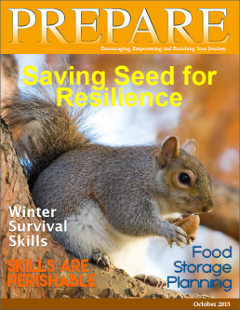
It’s interesting that Abby submitted this article while our most recent issue was in at the design desk. She had no way of knowing, other than that ‘feeling in the air’ what the cover of the most recent issue would be! You can get this exact Issue for FREE if you subscribe before November 15, 2015.
<- Just take a look at how appropriate it is in regards to this topic!
As with all of our Authors, Abby endeavors to live a more self-sustaining lifestyle. Her steps toward this lifestyle have taken her into her area of expertise. We are happy to introduce her to you and hope you will connect with her at the end of reading this article. Look for more from Abby within the upcoming pages of PREPARE Magazine!
_________________________________
Squirrel Syndrome
By Abby Artemisia, http://www.mightyoakfromlittleacorn.com/
 As I write this, it’s mid-October and I’m seriously suffering from Squirrel Syndrome. One of the last times I was in Asheville, my friend pointed to a squirrel, frantically running across the road with a nut in its mouth, and exclaimed, “Look, that’s you!”
We both burst out laughing, but it struck a chord somewhere deep inside of me. Then she said, “But just think, soon it will be winter and you can stop foraging.” Instead of calming me, that remark panicked me.
So what’s “Squirrel Syndrome” you ask. It’s when I feel like one of those squirrels who tries to run under your tires. I imagine their mouths are full of high-protein, health-supporting, oil-rich nuts, going to the equivalent of their root cellar. I start to believe they’re so hyper-focused on getting in the last of the available wild food, they barely (on a good day) stay alive.
That’s what I feel like this time of year. I have a list of at least twenty species of wild edibles and 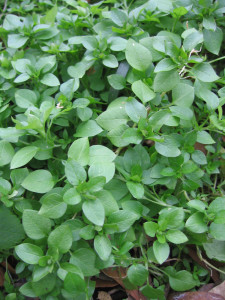 medicinals I want to harvest and preserve before it’s too late. I’ve been trying to get to the wild greens before they’re frost damaged, including things like sochan (the Cherokee word for cut-leaf coneflower) and raspberry leaf for tea. Luckily some greens like chickweed are hardier and will stick around most of the winter.
 This is the perfect time of year for digging roots. My friend and I have been teaching about roots lately, like dandelion, burdock, chicory, and sun chokes (aka Jerusalem artichoke [neither from Jerusalem or an artichoke]). They’re all in the Aster family, and all have inulin, shown to help balance blood sugar, and prebiotics, the food for probiotics in our body.

And, of course, who can forget: nuts! Around here, there don’t seem to be many acorns this year. It changes from year to year. How about where you are? They can be a lot of work, but I think they’re worth it. I wish I would have harvested more chestnuts, but there still seem to be plenty of hickory nuts and black walnuts.
Instead of succumbing to the panic of Squirrel Syndrome, I’ve decided to remember about Thanksgiving, my favorite holiday. I love this holiday because:
1) you aren’t expected to buy gifts for anyone, and
2) it’s all about gratitude for everything, but especially the abundance of nourishing, fresh food.
In that vein, I’m grateful that I got chestnuts at all this year. I’m grateful that the hickory and walnuts can wait to be processed until squirrel (syndrome) season is over. I’m grateful for the elderberries, pawpaws, and persimmons I harvested when I went home to Ohio to visit. I’m grateful to live in such an incredibly biodiverse region with so much wild food and medicine. I’m grateful, that though foraging is a lot of work, I get to do it in beautiful locations. Most importantly, I’m grateful to the plants for giving parts of themselves or even their whole lives so freely for my nourishment. Now off to gather the last of the nettles! Happy foraging!
_________________________________
Abby Artemisia is a botanist, herbalist, professional forager and mom living in a small community in the Blue Ridge Mountains. She received her botany degree in Ohio, worked on organic farms across the country, and learned about plant medicine and spirituality from Native Americans. Abby teaches about edible and medicinal plants and mushrooms, while foraging as much as possible. Her mission is to inspire nature (re)connection and health empowerment.
Visit Abbey’s Website: http://www.mightyoakfromlittleacorn.com/
Instagram: https://instagram.com/abbyfrolickingintheforest/
Facebook Page: https://www.facebook.com/AbbyBotanistHerbalist/
Popular Questions
What is the fastest way to improve It’s “Squirrel Syndrome” Time of Year without making beginner mistakes?
The fastest way to improve It’s “Squirrel Syndrome” Time of Year is to simplify the process and control one variable at a time. Start with the most important baseline: define the goal, identify the main failure point, and test one change before making another. Keep short notes so you can connect the outcome to the adjustment you made. This prevents guesswork and helps you build a repeatable method instead of chasing random fixes.
What should you check first when It’s “Squirrel Syndrome” Time of Year is not working well?
Check the most immediate bottlenecks first: setup errors, missing inputs, bad timing, or inconsistent follow-through. Before buying anything new or changing the whole system, confirm that the basics are being done correctly and consistently. A small diagnostic checklist usually reveals the real problem faster than broad trial and error. Once the weak point is clear, make one correction and watch the result before adjusting anything else.
What common mistakes make It’s “Squirrel Syndrome” Time of Year harder than it needs to be?
The most common mistakes are changing too many variables at once, skipping the basics, and judging results too quickly. Many people also copy generic advice without adapting it to their exact situation, which leads to weak results and confusion. A better approach is to work from a simple baseline, make measured changes, and give each change enough time to show whether it helped. That makes progress easier to track and repeat.