
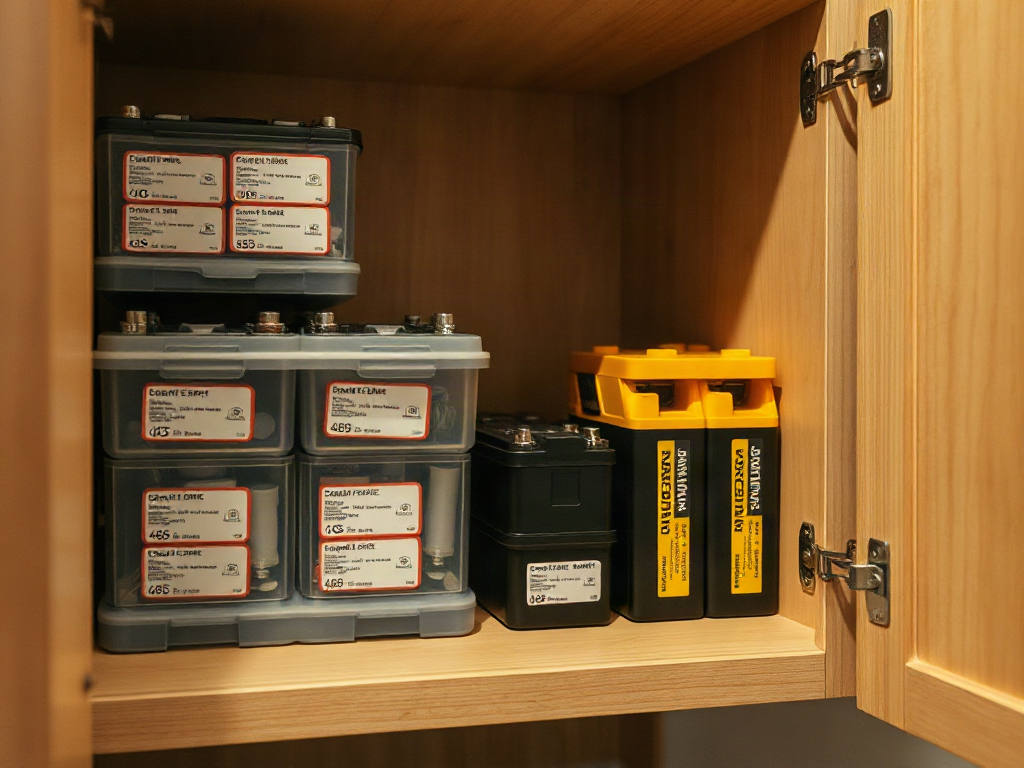
Battery storage safety for preparedness means matching each battery chemistry to a cool, dry location while preventing short circuits, physical damage, and unsafe charging. Keep loose cells in individual cases or original packaging, isolate terminals, and separate damaged or swollen batteries from usable supplies. Rechargeable lithium-ion packs need compatible chargers and periodic inspection, while lead-acid batteries require ventilation, upright positioning, and protection from accidental contact. A dependable reserve also needs dated inventory checks, rotation through normal use, and smoke or heat response planning; stored energy should never be treated as harmless simply because a battery is disconnected.
What you’ll learn
This guide covers the following practical points:
- Match Storage Conditions to Battery Chemistry — Battery chemistry determines how a preparedness reserve should be stored, inspected, and charged.
- Prevent Shorts, Heat, and Physical Damage — Short-circuit prevention is the first physical control for a household battery cache.
- Build a Safe Rotation and Inspection Routine — A battery reserve is safer and more useful when it is treated as working inventory rather than forgotten stock.
- Plan for Charging and Battery Failure — Safe charging requires the charger, battery, cable, and power source to be compatible.
Match Storage Conditions to Battery Chemistry
Battery chemistry determines how a preparedness reserve should be stored, inspected, and charged. Alkaline primary cells, rechargeable nickel-metal hydride cells, lithium-ion power banks, and lead-acid batteries do not share identical risks. Treating every battery as interchangeable can lead to leakage, reduced capacity, charging errors, or a more serious heat event.
Common household alkaline batteries are best kept in their original package or a rigid organizer that prevents terminals from touching. Avoid mixing old and new cells in the same device because weaker cells may leak or fail under load. Rechargeable nickel-metal hydride batteries gradually lose charge in storage, so emergency sets need scheduled testing rather than an assumption that a full charge months ago remains available.
Lithium-ion packs deserve closer attention to temperature, physical condition, and charger compatibility. Do not store them in a vehicle year-round, on a sunny windowsill, or beside fuel and other combustible supplies. A power bank that is swollen, cracked, unusually hot, hissing, leaking, or producing an unfamiliar odor should not be charged or returned to the supply bin.
Lead-acid batteries used with backup systems are heavier and can expose terminals capable of delivering substantial current. Keep them upright where required by their design, protected from being knocked over, and away from children. Follow the battery and system manufacturers’ instructions for ventilation, charging, clearances, and compatible components; a sealed case does not make every installation suitable for an occupied closet.
Prevent Shorts, Heat, and Physical Damage
Short-circuit prevention is the first physical control for a household battery cache. Coins, keys, tools, wire, and neighboring batteries can bridge exposed terminals. The resulting current may create rapid heating even when the battery looked normal before contact.
Store loose batteries in purpose-made cases with separate slots. If original packaging is unavailable, protect exposed terminals using a method recommended for that battery type and keep cells from moving against conductive objects. A plastic bag containing a handful of loose batteries is not a protective container; the cells can still touch each other inside it.
Location matters as much as packaging. Choose a dry interior cabinet with a stable room temperature, rather than an attic, outdoor shed, damp basement floor, furnace room, or unconditioned vehicle. Keep the cabinet clear of paper, solvents, fuels, and escape paths. Batteries should not block a doorway or sit where a failure could make the household’s primary exit difficult to use.
Consider an illustrative preparedness setup: a family keeps alkaline cells for radios, rechargeable cells for lanterns, and two lithium-ion power banks. The alkaline and rechargeable cells occupy labeled compartments in one organizer, while the power banks sit separately on a stable shelf where they can be inspected without unpacking the entire cache. Chargers remain with their matching devices. This arrangement reduces terminal contact, chemistry mix-ups, and rushed charger selection during an outage.
Build a Safe Rotation and Inspection Routine
A battery reserve is safer and more useful when it is treated as working inventory rather than forgotten stock. Mark the purchase month or entry date on each package without covering safety information. Use older undamaged supplies first, replace depleted stock, and avoid combining batteries of different ages, brands, capacities, or chemistries in a multi-cell device unless its manufacturer permits it.
Set an inspection interval that fits the equipment and manufacturer instructions. A practical household routine is to inspect the cache during other scheduled preparedness reviews and before periods when outages are more likely locally. Rechargeable products may require more frequent attention because self-discharge, battery-management electronics, and standby power use vary by model.
Use this compact inspection sequence:
- Read the label: confirm chemistry, date, voltage, and intended device.
- Check the case: look for swelling, cracks, corrosion, leakage, discoloration, or damaged cables.
- Check the location: verify that the area is dry, moderate in temperature, and free of conductive clutter.
- Test usable equipment: operate radios, lights, and power banks according to their instructions.
- Record the result: note charging, replacement, or disposal needs so defects are not forgotten.
An inventory that passes visual inspection but cannot run its assigned equipment is still failing. Test batteries with the actual radio, lantern, medical accessory, or communications device when doing so is safe and consistent with product directions. If runtime becomes sharply shorter, charging becomes erratic, or heat appears during ordinary use, remove the item from the ready supply and investigate rather than counting it as backup capacity.
Plan for Charging and Battery Failure
Safe charging requires the charger, battery, cable, and power source to be compatible. A connector that physically fits does not prove that voltage, current, battery chemistry, or charging controls match. Use equipment specified by the manufacturer, place charging products on a stable surface away from combustible clutter, and do not charge a damaged battery.
Charging deserves active observation. Avoid placing a charging power bank beneath bedding, inside a packed bag, or where heat cannot dissipate. If a battery becomes unusually hot, changes shape, vents, smokes, or makes popping or hissing sounds, do not handle it as though it were an ordinary depleted cell. Move people away, call emergency services when there is smoke, fire, or immediate danger, and follow local fire-department direction. Do not improvise with a response that requires picking up a failing battery.
Removal and disposal are part of the safety plan. Isolate a questionable battery from usable inventory without crushing, puncturing, or exposing it to water, and consult the manufacturer or local household hazardous-waste program for handling instructions. Lithium-ion and rechargeable batteries generally should not be placed loose in household trash or curbside recycling. Local acceptance rules differ, so confirm the destination before transport and protect terminals as directed.
Large home energy storage systems require a different level of planning from portable preparedness batteries. Installation location, electrical protection, ventilation, fire separation, permits, and emergency access may be governed by product requirements and local codes. Use qualified installers and coordinate with the authority having jurisdiction rather than scaling up a portable-battery storage method.
Frequently Asked Questions
Should batteries be stored in a refrigerator?
Usually not. Moisture and condensation can damage batteries or terminals, while most consumer batteries are intended for a cool, dry place within the manufacturer’s stated temperature range.
Can loose batteries be kept together in a plastic bag?
No. Terminals can touch inside the bag or contact another metal object. Use original packaging or a rigid battery case with separate compartments.
How often should preparedness batteries be checked?
Follow each manufacturer’s instructions and include batteries in scheduled preparedness reviews. Inspect rechargeable packs more often if they self-discharge quickly, power critical equipment, or show changing runtime.
Is a swollen lithium-ion battery still safe to use?
No. Stop using and charging it, keep people away from immediate hazards, and obtain manufacturer or local hazardous-waste instructions without puncturing, crushing, or mailing it casually.
Can different battery brands or ages be used together?
Avoid mixing brands, ages, charge levels, capacities, or chemistries in a multi-cell device unless the device manufacturer explicitly allows it. Mismatched cells can discharge unevenly and increase leakage or performance problems.
Conclusion
A reliable battery reserve begins with chemistry-specific instructions, protected terminals, moderate temperatures, and a location away from combustible clutter and exit routes. Label and rotate supplies, test them in their assigned equipment, and remove any cell showing swelling, leakage, damage, unusual heat, or unstable charging. Review chargers and disposal options before an outage, when time and safe alternatives are still available. Large stationary systems should be handled as professional electrical and fire-safety installations, not oversized versions of a portable battery bin.
Additional Resources
Authoritative Sources
- Battery Energy Storage Systems: Frequently Asked ...
mass.govBattery energy storage systems (BESS) are lowering costs and improving energy reliability across the country.
- Battery Energy Storage Systems: Main Considerations for ...
epa.govEPA has developed comprehensive guidance to help communities safely plan for installation and operation of BESS facilities as well as recommendations for ...