
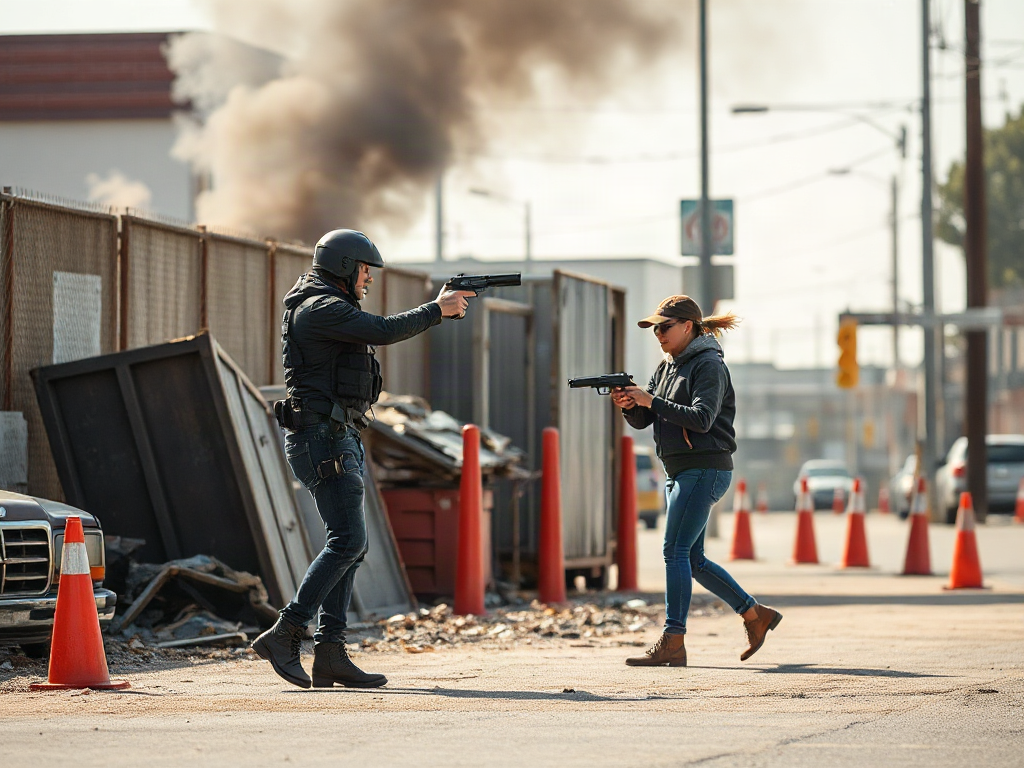
Practical self-defense boundaries during disasters rely on clear verbal limits, physical distance, early movement, and a safe exit rather than confrontation. State what you need in plain language, keep an obstacle or several steps between you and an agitated person, avoid being trapped in a vehicle or room, and leave before the interaction becomes physical. Disasters increase risk through crowding, uncertainty, fatigue, scarce supplies, and disrupted communication, but those pressures do not justify threatening behavior. A calm voice, visible hands, trusted companions, and contact with emergency personnel can reduce danger; carrying a weapon or trying to protect property may create greater legal and physical risks.
What Boundaries Look Like Under Disaster Pressure
A self-defense boundary is a clear limit paired with an action you control. It may sound like, “Please step back,” followed by moving toward an open, populated area. The boundary is not a demand that another person behave perfectly; it is a way to communicate your limit while preparing to reduce contact. During a disaster, that distinction matters because shelters, fuel lines, aid stations, apartment hallways, and evacuation vehicles can compress strangers into stressful spaces.
Scarcity and uncertainty can make ordinary disagreements feel urgent. People may be tired, worried about relatives, confused by conflicting information, or angry about delays. Those conditions explain pressure but do not make intimidation acceptable. A person who blocks a doorway, reaches into your belongings, follows you after you move away, or repeatedly ignores a stated limit is giving you information about rising risk. Treat the behavior as a safety problem rather than as a debate to win.
Useful boundaries are brief and observable. “Do not touch my bag” is clearer than an accusation about someone’s character. “I am leaving now” communicates an action without inviting negotiation. Avoid threats, insults, or claims about what you will do to the other person, particularly when witnesses, children, or responders are nearby. A calm statement also gives bystanders and staff a recognizable moment to support you.
Readers preparing for a crisis should write a few phrases in advance and practice saying them without shouting. Link each phrase to a response: create space, bring a companion, notify staff, or leave. The boundary is working when the person backs off, the conversation ends, or you reach a safer location. It is failing when the person closes distance, blocks movement, escalates language, or recruits others into the confrontation. At that point, repeating yourself is usually less useful than changing location.
For related household preparation, Practical self-defense boundaries during disasters should be treated as part of an evacuation and communication routine, not as a separate combat skill.
Distance, Position, and Early Exit Choices
Position often determines whether a boundary remains voluntary. Stand where you can see the person’s hands and keep access to an exit, staffed counter, neighbor, or other visible group. Do not allow yourself to be pressed against a wall, vehicle, stairwell, fence, or shopping cart. A table, counter, parked vehicle, or row of chairs can provide useful separation while you decide what to do next.
Distance should be adjusted to the setting. In a crowded shelter, several feet may be difficult, so place yourself beside an adult companion or near a worker rather than attempting to force a personal space bubble through a dense line. In an empty parking area, distance and lighting become more valuable; cross toward an occupied building or call for assistance before an argument develops. A person who continues approaching after you move away deserves more caution than someone who remains stationary and speaks from a distance.
Movement should be early and ordinary when possible. Leaving a line before tempers peak may cost your place, but staying can expose you to a more serious problem. Tell a worker why you are stepping away and ask how to rejoin later. If a stranger follows, do not lead that person to your room, vehicle, or family members. Move toward staff, security, a reception desk, a group of known neighbors, or a location where emergency services can be contacted.
A common mistake is focusing on the person’s hands while ignoring the environment. Check whether a door opens outward, whether your child can move with you, whether smoke or debris blocks a route, and whether a mobility limitation changes your options. Another mistake is assuming a familiar neighborhood is safe after power or communications fail. Darkness, damaged structures, and reduced staffing can alter normal routes. Walk evacuation paths beforehand when practical, and identify more than one destination.
Physical readiness should support escape rather than encourage engagement. Wear footwear that permits movement, keep essential medication accessible, and avoid carrying loose items that can fall or snag. These choices are modest, but they reduce the chance that a trip, locked door, or forgotten phone turns a manageable encounter into a trapped one. Use the broader disaster self-defense boundary plan to match routes and companions to the actual site.
Verbal De-Escalation Without Surrendering Safety
De-escalation is not the same as appeasement. It means reducing unnecessary friction while preserving your ability to leave. Keep your voice low enough that the other person must listen rather than compete with you. Use short sentences, avoid sudden gestures, and keep your hands visible without pointing or reaching toward the person. A neutral phrase such as “I am not discussing this here; I am moving to the help desk” redirects the interaction toward a concrete action.
Do not argue over motives during an emergency. Statements such as “You are trying to rob me” or “You must be drunk” can provoke denial and anger without improving your safety. Describe the observable behavior and your response: “You are standing in front of the exit. I need a clear path, and I am calling staff.” If the person wants an explanation, repeating the same short limit may be safer than adding details about your supplies, family, or destination.
Companions need assigned roles. One adult can speak while another gathers children or contacts a worker. Several people shouting at once may look like a group confrontation and can increase confusion. A child should not be sent to negotiate with an adult who is acting aggressively. Agree beforehand on a simple meeting point and a phrase that means “leave now,” especially when noise, poor reception, or a damaged power grid makes phone calls unreliable.
Empathy has a narrow but useful role. “I understand the line is frustrating” can acknowledge pressure without agreeing to unsafe conduct. Do not offer your entire supply bag, personal information, or vehicle access merely to end a tense conversation. That may be reasonable when sharing a low-risk item, but it is a poor response to stalking, forced entry, or repeated demands. The tradeoff is situational: cooperation with aid staff may solve a resource dispute, while continued discussion with an unknown person may expose your family to more risk.
Watch for signs that words are no longer controlling the interaction: clenched fists, sudden silence, scanning for witnesses, blocking movement, threats, unwanted touching, or attempts to separate you from companions. These signs do not prove what someone will do, but they justify more distance and faster help-seeking. A boundary is a safety tool, not a test of courage.
Household Rules, Supplies, and Shared Spaces
Many disaster conflicts begin with unclear access rather than deliberate violence. Neighbors may ask for fuel, food, batteries, water, tools, or a place to charge a phone. Decide in advance what your household can share, with whom, and through which method. A small public distribution point is safer than opening your home to an unfamiliar person. Sharing a measured amount through a door, gate, or community coordinator preserves a boundary that informal visits can weaken.
Keep valuable supplies out of casual view and avoid discussing inventory in public lines or online posts. Store essential items so one person cannot remove everything without another adult noticing, but do not create improvised traps or hazardous barriers. Locking doors, improving exterior lighting when power permits, and maintaining working smoke and carbon-monoxide alarms address household safety without turning the home into a confrontation zone.
Shared spaces require rules that are easy to enforce. In a shelter or apartment building, establish who can enter a room, where bags are placed, how children check in, and which staff member handles disputes. A sign, spoken rule, or group message can prevent misunderstandings, but it will not stop someone who intends to trespass. Report repeated violations early, document times and descriptions when safe, and avoid physically guarding property if leaving is the safer choice.
Property protection has limits. A phone, generator, or stored food may be expensive or difficult to replace, yet pursuing a thief into darkness can expose you to unknown companions, damaged ground, or weapons. Prioritize people, escape routes, medication, identification, and communication over objects. A useful household drill is to ask, “If someone enters the yard, where do we go, who calls, and which door remains clear?” The answer should not depend on one adult confronting the intruder.
Use clear household boundaries for disaster situations alongside local shelter rules and emergency instructions. Personal judgment still matters because a rural property, high-rise building, evacuation bus, and crowded relief center present different exits, witnesses, and response times.
When a Threat Becomes Immediate
Immediate danger changes the priority from explaining a boundary to creating survival space and obtaining help. If someone grabs you, attempts to force entry, displays a weapon, or blocks your only route while making a credible threat, use the safest available exit and contact emergency services when possible. Loudly call for specific help—“You in the blue jacket, call emergency services”—rather than relying on a general request that bystanders may ignore.
Use only the force reasonably necessary to break contact and escape, and follow applicable local law. Legal standards vary by location and circumstances, so this article is not legal advice. Do not chase someone who leaves, recover property at personal risk, or keep escalating after you can safely disengage. If a weapon is present, distance, cover, and an unobstructed escape may matter more than trying to control the person.
After reaching safety, account for children and companions, move away from doors and windows if the threat remains nearby, and provide responders with precise observations: location, direction of travel, clothing, vehicle description, injuries, and whether a weapon was seen. Avoid exaggeration or speculation. If you are injured, seek medical attention even when the injury appears minor, and preserve relevant messages or video without returning to the danger area.
A frequent failure mode is waiting for certainty. You do not need to prove that a person intends harm before leaving a vulnerable position. At the same time, suspicion alone does not justify attacking or accusing someone. The practical middle path is early separation, visible help-seeking, and proportionate action. Review what happened later with your household: which route worked, where communication failed, and what change would reduce exposure next time.
Practice a compact priority sequence: notice the behavior, state one limit, create distance, move toward people or staff, call for help, and leave the area. It is not a guarantee of safety, but it is more reliable than improvising a confrontation while frightened, tired, or responsible for children.
Frequently Asked Questions
What is a practical self-defense boundary during a disaster?
It is a clear limit paired with a safety action, such as saying “Do not touch my bag” while moving toward staff or an open exit.
Should I confront someone who is taking supplies?
Prioritize people and escape over property. Notify staff or emergency services, avoid pursuit, and do not enter a dark or isolated area to recover items.
How can I de-escalate without appearing weak?
Use a calm voice, visible hands, short statements, and a clear movement plan. Leaving and seeking help is a safety decision, not a surrender.
Where should I stand during a tense interaction?
Choose a visible position with an unobstructed exit and some separation. Avoid being pinned against walls, vehicles, fences, or blocked doorways.
When should I call emergency services?
Call when there is immediate danger, forced entry, unwanted physical contact, a weapon, credible threats, or a person who prevents you from leaving safely.
Conclusion
Effective disaster self-defense is built around early recognition, clear limits, distance, and a route away from trouble. Decide before an emergency how your household will share supplies, regroup, contact help, and leave crowded or isolated locations. During an encounter, describe the behavior, state one boundary, avoid arguing about motives, and move toward staff, companions, witnesses, or an open exit. Treat pursuit, blocking, touching, and weapon displays as signals to stop negotiating and seek immediate assistance. Property may be replaceable; a trapped family member or escalating confrontation carries a different cost. Rehearse a few calm phrases and one simple exit sequence so your response remains practical when fatigue, noise, and uncertainty make improvisation difficult.