
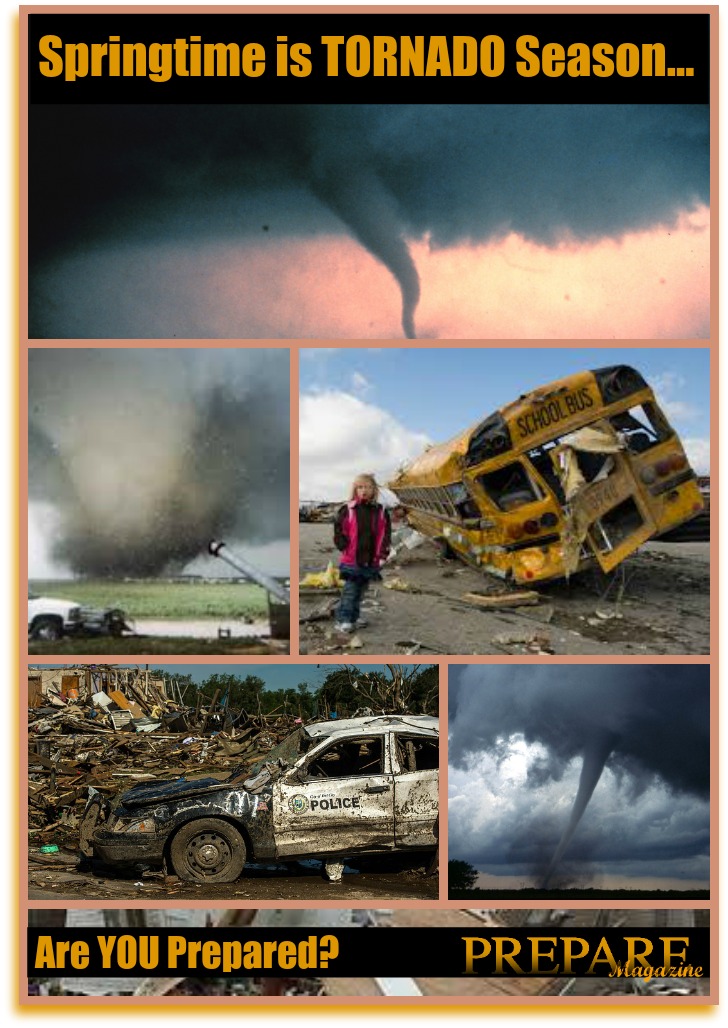
 Severe Spring Weather Awareness Week continues. Today we focus on Tornadoes.
Tornadoes are fierce by nature. A tornado is a strongly revolving pillar of air extending from the base of an electrical storm to the ground. They are capable of completely damaging well-made frameworks, rooting out trees and also hurling things with the air like harmful missiles. Twister/Tornado intensities are identified on the Fujita Scale with ratings between F0 (weakest) to F5 (strongest). Although extreme tornadoes are much more usual in the Plains States, twisters of all ratings have been stated in every single state in America.
Watch or Warning – What’s the Difference?
A Tornado Watch Means – Tornadoes are most likely in, as well as near the area under the ‘watch’. This is the time to quickly evaluate and review your emergency situation strategies,as well as inspect your supplies and be sure they are readily available. Be prepared to move to your protected space with ample supplies and protection. Be prepared to act swiftly if this precaution is upgraded to a Warning or if you believe that a tornado is actually in your area. Early action saves lives!
A Tornado Warning Means – A tornado has actually been spotted or shown on radar in the Warning Area. Tornado warnings suggest impending threat to life as well as building, commercial, municipal and residential property. Instantly retreat under ground to a basement, storm cellar or an interior area such as a hall closet or storage room, a corridor, hallway or restroom away from windows.
Know the Indications of a Tornado
There is no replacement for keeping a sharp on the sky. Weather forecasting and scientific research are not always ideal and some tornadoes do happen without a tornado warning. Besides an obviously noticeable tornado, here are some points to look as well as listen closely for during tornado season:
- Solid, consistent turning in the cloud base.
- Whirling dust or particles on the ground under a cloud base. Tornadoes sometimes have no channel!
- Hail or hefty rainfall accompanied by either a dead calm or a quick, intense wind shift. Many twisters are covered in hefty rainfall and cannot be viewed.
- Day or night – Loud, constant roar or roll sound, which doesn’t fade in a few secs like thunder.
- Evening – Tiny, intense, blue-green to white flashes at ground level near a thunderstorm (instead of silvery lightning up in the clouds). These flashes mean that power lines are being snapped by quite sturdy wind, perhaps a tornado.
- Night – Relentless lowering of the cloud base, brightened or silhouetted by lightning (especially if it is on the ground or there is a blue-green-white power flash below).
 What to do?
Often deciding what to do depends on where you are at the time. Since tornadoes have little warning time proceeding the danger, you and your loved ones may be in a variety of places when danger strikes. We will try to list many potential places but this is likely not an all inclusive list.
A residence with a basement: Avoid windows. Get in the basement and also under some sort of sturdy protection (massive table or work bench), or cover yourself with a mattress or sleeping bag. Know where extremely heavy objects are located on the floor above (pianos, fridges, waterbeds, and so on) and be aware not to be located under them. They could fall down through a weakened flooring and crush you. Head protection, such as a helmet, can offer some additional security as things fall through floors or off walls in the basement.
A residence without a basement, a dormitory, or hotel or apartment: Avoid windows. Go to the lowest flooring. Locate a facility area (like a bathroom or storage room), or under a stairwell, or in an interior corridor without windows. Crouch to the floor, facing down; and also cover your head with your hands or another padded object. A bath tub might provide a covering of partial security. Also in an indoor room, you should cover yourself with some form of thick padding (cushion, quilts, and so on), to secure against falling particles in situation the ceiling and/or roofing system (which often contain pipes/sprinklers) were to fail. A helmet could offer some protection to avoid head injury.
An office structure, healthcare facility, nursing house or skyscraper: Go directly to an enclosed, windowless location in the center of the structure– far from glass and on the lowest flooring feasible. Then, crouch down and cover your head. Inside stairwells are normally excellent areas to nestle, and if not crowded, allow you to get to the bottom level swiftly. Avoid the escalators and elevators; you might be caught in them if the power is lost.
A mobile home: Get out! Even if your home is tied down, it is not as secure as an underground shelter or long-term, sturdy structure. The majority of twisters can damage even tied-down mobile houses; and also it is best not to play chance given the low probabilities that yours will make it. As soon as conditions appear to for tornadic activity, plan to go to one of the are shelters, or to a close-by long-term structure early enough.
At school: Follow the drill! Go to the interior venue or area in an organized way as you are told. Crouch low, head down, and protect the back of your head with your arms. Steer clear of from home windows as well as huge open areas like gyms and amphitheaters.
A vehicle: Cars and trucks are very unsafe in a twister. There is no safe alternative when caught in a tornado while in a motor vehicle, just somewhat less-dangerous ones.
- If the tornado shows up, from far away, and the traffic is light, you might be able to drive out of its course by moving at right angles to the twister. Drive in this manner to seek shelter in a solid, permanent structure, or underground if possible.
- If you are caught by extreme winds or flying particles, park the car as promptly and safely as feasible off of the main traffic or street. Remain in the auto with the safety belt on. Put your head down below the front windows; cover your head with your hands as well as a blanket, jacket or extra shirt if possible.
- If you can safely get your body lower than the level of the highway, (such as a ditch) leave your vehicle and lie in that location, covering your head with your hands, blanket, jacket or pillow. Avoid seeking shelter under bridges, which can collapse or produce dangerous traffic hazards while providing almost no security against flying particles.
The Great Outdoors: If possible, look for shelter in a strong structure. If not, lie flat and face-down on the lowest point of ground you can quickly find, protecting the rear of your head with your arms. Find a position, lower than ground level if possible, as far away from trees and vehicles as you possibly can; they might be blown into you during the tornado.
A shopping mall or large department store: Do not panic. Expect others to panic. Move as rapidly as you are able to an indoor bathroom, storage room, stairwell or any other tiny encased location, away from windows.
At church or a movie theater: Again do not panic. Ideally, relocate yourself and others quickly but in an organized fashion to an indoor bathroom or hallway, far away from any windows. Crouch face-down and also secure your head with your arms. If there is no time at all to do that, get under the seats or pews, securing your head with your arms or hands.
Are Tornadoes the same as Hurricanes?
The short answer to this is: “No” It is essential to not ever confuse a tornado with a hurricane or any other type of tropical cyclone since tornadoes and hurricanes are extremely different weather disasters. Quite possibly the only resemblance between the two is that they both consist of strong revolving winds that could create excessive damage and bodily harm.
For a Quick Reference about the vast differences, we’ve included the image below.
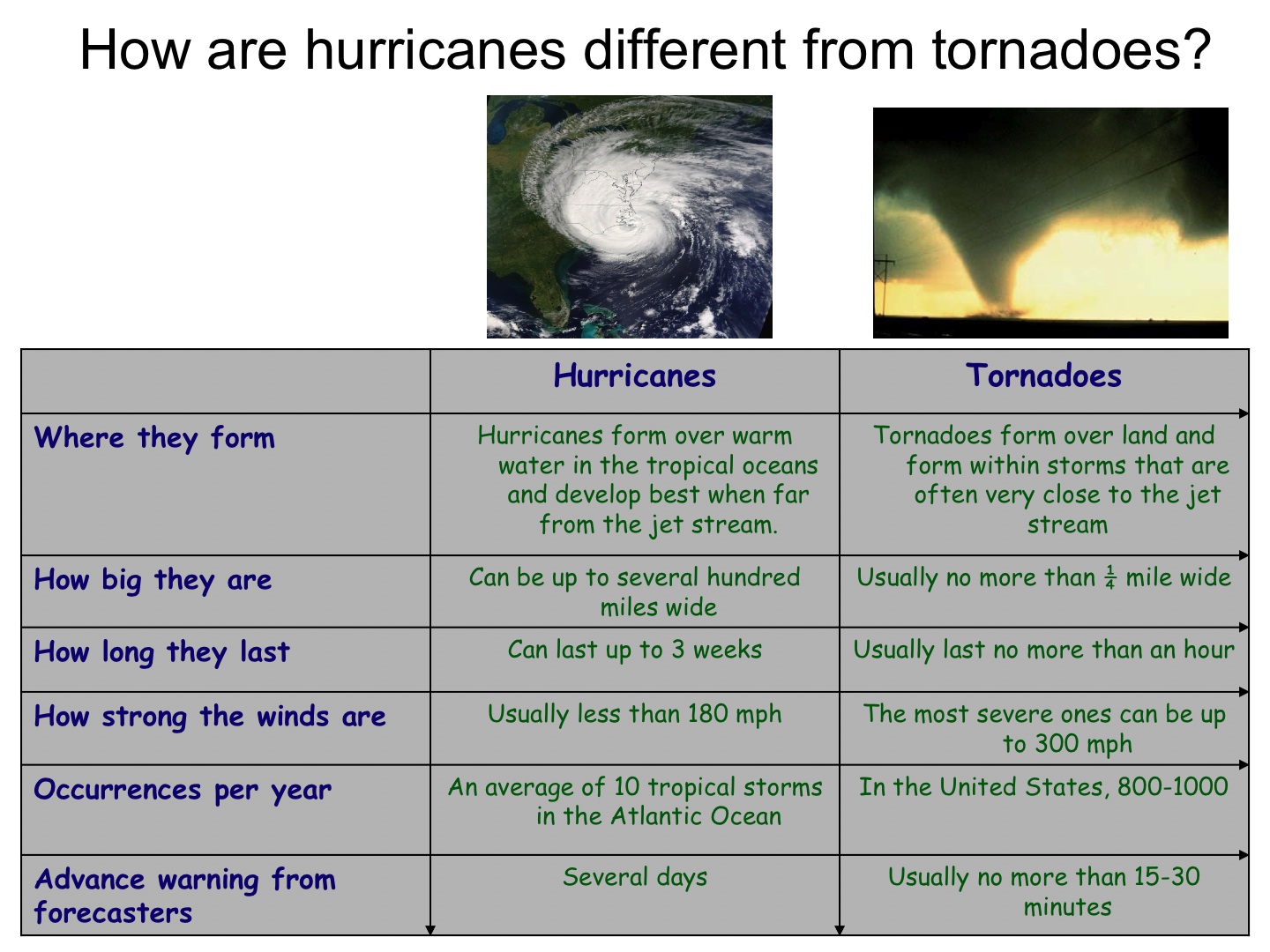
Image found on HurricaneScience.org
But we’re still a few weeks away from Hurricane Season.
Let’s stay focused…there’s always more for which we can prepare.
Please share so we can all help each other be better prepared! Thank you!
Popular Questions
What should I do during Severe Spring Weather Week if a tornado watch is issued?
When a tornado watch is issued, it means that conditions are favorable for tornadoes in your area. Take this time to review your emergency plans and ensure your supplies are ready. Stay alert for updates and be prepared to move to a safe location if a warning is issued. Early preparation can significantly increase your safety during severe weather.
How can I recognize the signs of a tornado during Severe Spring Weather Week?
During Severe Spring Weather Week, it's crucial to know the signs of a tornado. Look for a rotating cloud base, whirling dust on the ground, or a loud, continuous roar that doesn't fade like thunder. Additionally, be aware of sudden calmness or heavy rain followed by a strong wind shift, as these can indicate a tornado is nearby. Staying vigilant can help you react quickly to potential danger.
What actions should I take if a tornado warning is issued during Severe Spring Weather Week?
If a tornado warning is issued, it means a tornado has been spotted or indicated on radar. Immediately seek shelter in a basement or an interior room away from windows. Crouch down and protect your head with your arms or a sturdy object. Acting quickly can save lives, so don’t hesitate to move to safety.
How can I stay safe in a mobile home during Severe Spring Weather Week?
Mobile homes are particularly vulnerable during tornadoes, so it's essential to have a plan in place. If a tornado warning is issued, leave your mobile home immediately and seek shelter in a nearby sturdy building or designated storm shelter. Do not stay in your mobile home, even if it is tied down, as it may not withstand strong winds. Planning ahead can ensure your safety during severe weather events.
What should I do if I am caught in a vehicle during Severe Spring Weather Week?
If you find yourself in a vehicle during a tornado, your safety is at risk. If possible, drive at right angles to the tornado's path to escape. If you cannot escape, find a safe place to park, stay in the vehicle with your seatbelt on, and cover your head with your arms. Avoid seeking shelter under overpasses, as they can create dangerous wind tunnels.