
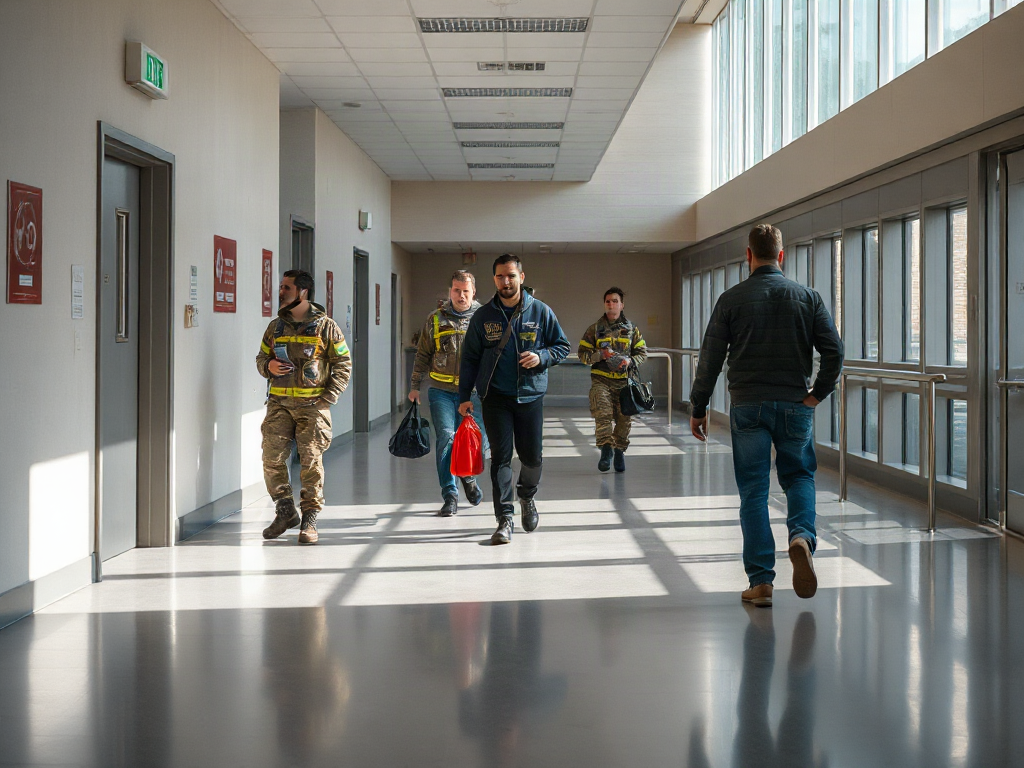
Effective evacuation training exercises test whether people can recognize the alarm, choose a safe route, assist anyone needing support, report to the assembly area, and complete accountability without re-entering the building. Start with announced walkthroughs, then progress to timed drills and realistic scenarios involving blocked exits, missing occupants, visitors, or communication failures. Observers should record decisions and bottlenecks rather than judging speed alone. A drill succeeds when responsibilities are understood and everyone is accounted for safely; unresolved confusion, unsafe shortcuts, and inaccurate attendance records require corrective action followed by another exercise.
Build Exercises Around Specific Evacuation Decisions
An evacuation exercise needs a defined test objective before anyone activates an alarm. “Practice leaving” is too broad to reveal whether the written procedure works. A useful objective identifies a decision or capability to examine, such as whether occupants recognize two exit routes, whether floor wardens clear assigned spaces, or whether the accountability team can reconcile employees, visitors, and contractors at the assembly area.
The hazard context should shape that objective. A fire scenario may require immediate movement by the nearest safe exit, while a chemical release could make one side of a property unsafe and require direction from incident personnel. Severe weather, smoke, loss of lighting, locked access points, and nearby traffic can change which route or assembly location remains usable. Exercises should reflect credible local conditions without using theatrical effects that create unnecessary risk or confusion.
Begin by defining the exercise boundary. Decide which building areas, shifts, occupants, and outside partners are participating. Record assumptions, including whether elevators are unavailable, whether a primary exit is blocked, and how emergency services will be distinguished from simulated responders. Notify alarm-monitoring services and other affected parties when appropriate so a training event is not mistaken for an actual emergency. Never disable required protection systems merely to make a scenario more challenging.
A compact planning check should cover:
- Objective: the action or decision being tested.
- Scenario: the condition that triggers evacuation and any simulated obstruction.
- Safety controls: stop signals, observer positions, weather limits, and provisions for medical needs.
- Participants: occupants, wardens, visitors, accountability personnel, and evaluators.
- Success evidence: observable results such as correct route selection and a reconciled attendance record.
A common mistake is combining too many complications in the first drill. Simultaneously blocking exits, simulating injuries, removing communications, and withholding attendee information may create noise rather than insight. A focused exercise gives evaluators a clearer view of cause and effect. Once a basic movement-and-accountability drill works, later Emergency evacuation plan training exercises can isolate harder conditions without overwhelming participants.
Progress From Walkthroughs to Disrupted Drills
Training should progress from explanation to independent performance. New occupants cannot be expected to improvise from a map they have never used, while experienced teams gain little from repeating an announced drill with an unobstructed primary exit. The exercise level should match participants’ familiarity, the building’s complexity, and the consequences of an error.
An orientation or tabletop discussion is the least disruptive starting point. Participants review alarm signals, exits, assembly areas, assigned duties, and procedures for reporting hazards or missing people. A tabletop is particularly useful for supervisors and wardens because they can examine questions that are difficult to resolve during a moving drill: Who brings the visitor log? Who contacts emergency services? Who has authority to relocate an assembly point? Discussion does not demonstrate physical performance, however, so it should not replace an evacuation.
A walkthrough adds movement without the pressure of a full alarm. Small groups follow primary and alternate routes, identify doors that require special operation, and locate the assembly area. This format suits unfamiliar facilities, recently revised floor layouts, and participants who need evacuation assistance. It also exposes practical barriers that look harmless on a plan, such as a route crossing a loading zone or an assembly location too close to responding vehicles.
A scheduled drill then tests coordinated action. Participants respond to the normal alarm or notification method, use the appropriate exits, and report for accountability. Observers should avoid coaching unless they see an unsafe act. If a person turns toward a familiar entrance instead of the nearest safe exit, that decision is valuable evidence about signage, habit, or incomplete instruction.
More advanced exercises introduce one controlled disruption. For example, an observer may mark the usual stairwell as unavailable and watch whether occupants select the documented alternative. Another drill might occur during a shift change, when rosters are least reliable. Unannounced exercises can test recognition and readiness, but they also create added risk for people with medical, mobility, sensory, or anxiety-related needs. They should be used only after baseline training, careful coordination, and suitable safety controls.
Progression is working when participants need less prompting, alternate routes are selected without unsafe hesitation, and assigned personnel perform their roles even when conditions change. It is failing when speed improves only because people ignore accountability, hold open protected doors, use prohibited routes, or assume a familiar alarm is “just another drill.”
Test Routes, Assistance, Communication, and Accountability
A credible drill examines the entire chain from warning to confirmed accountability. Measuring only the time required to reach an exterior door can reward unsafe behavior and conceal serious gaps. The more useful question is whether everyone received actionable information, moved by a viable route, reached a safe assembly point, and was accurately reported.
Route Selection and Movement
Observers should note congestion, hesitation, attempts to retrieve belongings, and doors that do not operate as participants expect. They should also watch whether people close doors when the plan requires it and keep access clear for responders. Timing can help identify bottlenecks, but a faster time is not automatically better. A controlled movement that protects people on stairs and avoids counterflow is preferable to rushing that causes falls or separates groups.
Route exercises should cover more than the primary path. Consider a workplace where most employees habitually enter through a front lobby, although two side exits are closer to their work areas. If everyone heads for the lobby during a drill, the issue may be behavioral familiarity rather than inadequate exit capacity. Marking the lobby route unavailable during a later exercise can test whether signs, maps, and instruction have made the alternatives usable.
Assistance and Communication
People who may need assistance should be included in planning without making assumptions about what they can do. Discuss preferred assistance, backup personnel, refuge procedures where applicable, mobility-device considerations, and communication methods before the drill. Plans must account for temporary limitations as well as known disabilities. A worker using crutches after an injury or a visitor unfamiliar with the alarm may need support even when the regular roster shows no accommodation requirement.
Communication should be tested under realistic noise and distance. Spoken directions that work in a quiet meeting may fail near machinery or outdoors. Visual notifications, public-address messages, text systems, radios, and face-to-face instructions serve different audiences and may fail in different ways. The exercise should verify who issues updates and how assembly leaders receive changes, not merely whether a message was sent.
Accountability Beyond a Head Count
Accountability requires a reliable expected-person list, a reporting method, and a process for resolving discrepancies. Employee rosters alone often omit visitors, contractors, remote staff, people at lunch, or workers who moved between departments. Assembly leaders should report missing or extra individuals through a defined channel rather than sending anyone back inside to search.
A practical set of Emergency evacuation plan training exercises should rotate accountability complications. One event might include a simulated visitor whose host has evacuated to another assembly point. Another might remove a roster runner and require the designated backup to act. These scenarios reveal whether the process depends on one person’s memory—a fragile arrangement that can fail during leave, injury, or shift changes.
Evaluate Performance and Correct Weak Points
Evaluation should connect observed behavior to a corrective decision. Comments such as “people were confused” or “the drill went well” are too vague to change the plan. Evaluators need to record where an issue occurred, what participants did, what condition influenced the behavior, and what consequence could follow during a real evacuation.
Use observers at decision points rather than clustering them at the assembly area. Useful locations include major intersections, stair entrances, exterior discharge doors, accessible egress areas, and roster collection points. Each observer should have a narrow assignment so observations remain comparable. One may record route choices while another tracks the time and accuracy of accountability. Photos or video may assist review only when organizational policy, privacy expectations, and site security allow their use.
Debrief immediately enough that details remain fresh, but do not let senior voices dominate. Ask participants what alarm they perceived, why they selected a route, where instructions became unclear, and what prevented them from completing an assigned role. A person who used the wrong exit may reveal that a sign was hidden by an open door; simply labeling the behavior “noncompliance” would miss the physical cause.
Corrective actions should be prioritized by safety consequence and operational dependency. A blocked exit, failed alarm device, or missing accommodation procedure warrants more urgent attention than a slightly delayed roster handoff. Each action needs an owner, a target date, and a verification method. Possible remedies include repairing hardware, relocating an assembly point, revising maps, updating visitor controls, clarifying backup assignments, or providing focused retraining.
Do not rewrite the entire plan after every imperfect drill. Some errors come from unfamiliarity and are better addressed through instruction; others expose a flawed procedure or facility condition. Compare the written expectation with what was physically possible. If trained participants repeatedly make the same reasonable choice, the plan may be working against the building layout or normal human behavior.
Close the cycle with a retest. If the first drill found inaccurate contractor records, the next exercise should verify the revised check-in and accountability process rather than merely repeating the evacuation. Keep exercise reports concise enough to use: objective, scenario, observations, safety concerns, corrective actions, owners, deadlines, and retest results. That record turns Emergency evacuation plan training exercises into a continuing validation process rather than a calendar obligation.
Frequently Asked Questions
How often should evacuation exercises be conducted?
Frequency should reflect applicable requirements, occupancy risks, staff turnover, operational changes, and previous drill findings. Retest promptly after correcting a serious weakness instead of waiting for the next routine exercise.
Should an evacuation drill be announced in advance?
Announced drills are appropriate for initial training and unfamiliar participants. Unannounced drills may test readiness later, but only with advance safety coordination and provisions for people who could be placed at risk.
Is evacuation time the best measure of success?
No. Time is useful for identifying delays, but route safety, alarm recognition, assistance, communication, and accurate accountability matter more than achieving the fastest exit.
Who should observe an evacuation exercise?
Use personnel who understand the plan but do not have conflicting response duties. Place them at route junctions, stairs, exits, assembly areas, and accountability stations with defined observation tasks.
When should a drill be stopped?
Stop or suspend it for an actual emergency, injury, dangerous crowding, severe weather, unsafe traffic interaction, or any condition beyond the exercise’s safety controls. Participants should know the stop signal beforehand.
Conclusion
Useful evacuation exercises test decisions, physical movement, communication, assistance, and accountability as one connected process. Begin with a narrow objective and an announced walkthrough, then add controlled complications only after participants can perform the basic procedure safely. Evaluate behavior at route choices and assembly points rather than relying on elapsed time alone.
The next practical step is to select one high-consequence weakness in the current plan and design an exercise around it. Assign observers, define stop conditions, include visitors and people needing assistance, and document what happens. Give every corrective action an owner and verification date, then retest the changed procedure. A plan becomes dependable through repeated evidence that people can use it under changing conditions—not through a successful drill that avoided its hardest assumptions.