
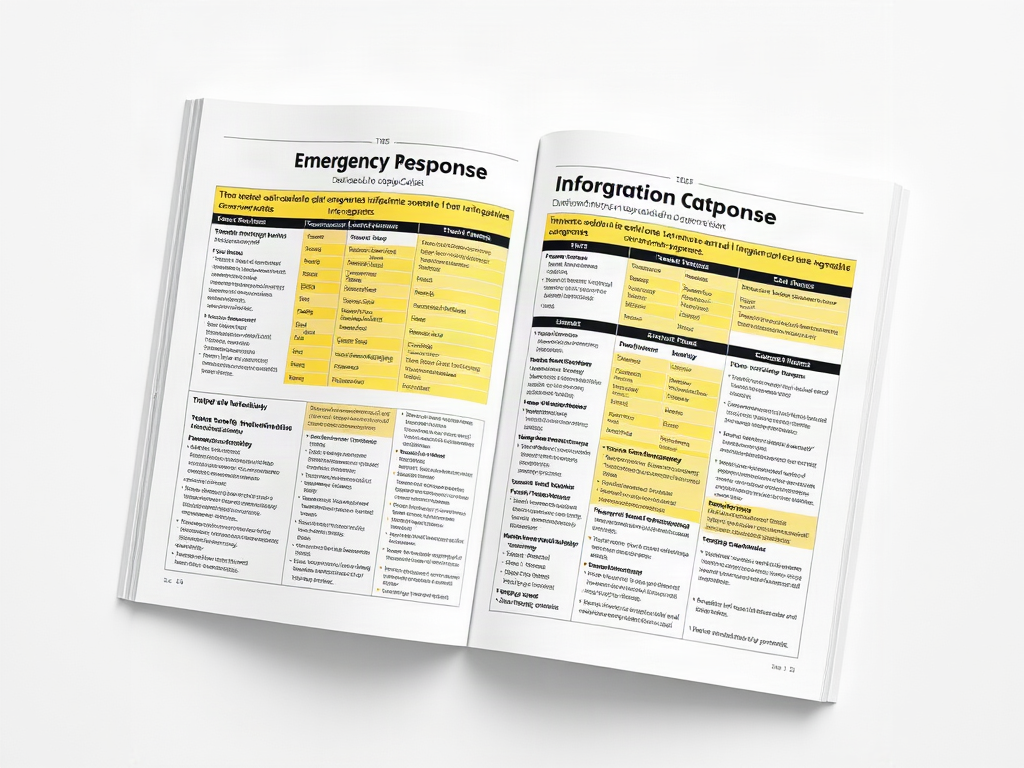
Emergency Response Guidebook information categories organize hazardous-material response data into white reference pages, yellow ID-number listings, blue material-name listings, orange action guides, and green isolation tables. Responders use the yellow or blue section to identify a substance, then follow its three-digit guide number to orange pages covering hazards, protective clothing, evacuation, fire, spill, and first-aid actions. Green-highlighted entries direct users to initial isolation and protective-action distances for certain toxic inhalation hazards. The guide supports decisions during the first phase of a transportation incident, but shipping papers, container markings, monitoring results, and qualified technical assistance should confirm the response.
How Does the Guidebook Organize Information?
The Emergency Response Guidebook, commonly called the ERG, is arranged around the sequence of decisions made during the initial phase of a hazardous-material transportation incident. A user first gathers visible evidence, identifies the material when possible, locates an action guide, and then checks whether special protective distances apply. Its color-coded sections shorten that search, but each category performs a different job and should not be treated as interchangeable.
The white pages provide instructions, identification aids, placard illustrations, container diagrams, and supporting explanations. Yellow pages list hazardous materials by four-digit identification number. Blue pages list materials alphabetically by name. Orange pages supply general hazard and response guidance under numbered guides. Green pages contain initial isolation and protective-action information for designated materials, including certain toxic inhalation hazards and substances that produce toxic gases when spilled in water.
Consider an overturned cargo tank displaying a readable four-digit number. The fastest route normally begins in the yellow index because the number is direct evidence. If shipping papers instead provide a proper shipping name but the number is obscured, the blue index may be more useful. Both indexes lead to an orange guide number; they are alternative entry routes rather than separate response systems.
A common failure is opening an orange guide based only on a familiar-looking placard or a guess about the cargo. Placards can narrow possibilities, but one placard may represent many materials with different properties. The safer process is to compare several clues: shipping papers, package labels, identification numbers, facility or carrier information, container type, and observations made from a safe location. Never approach a release merely to obtain a better view.
The categories work well when users understand their limits. The ERG is designed for early decisions such as recognizing broad hazards, establishing an initial perimeter, choosing defensive actions, and requesting specialized assistance. It does not replace a safety data sheet, carrier-specific technical data, atmospheric monitoring, an incident action plan, or advice from qualified hazardous-material personnel.
How Do the Yellow and Blue Identification Indexes Work?
The yellow and blue sections answer the same operational question from different starting information. Yellow is organized numerically by the material’s four-digit identification number, while blue is arranged alphabetically by shipping name. Each listing points to a three-digit orange guide and may use highlighting to signal that the green section requires attention.
Use the yellow index when a reliable UN or NA identification number is visible on a placard, orange panel, shipping paper, or package marking. Read all four digits carefully. Transposing two digits can send the user to an unrelated material and an unsuitable response guide. A second person should verify the number when staffing and conditions permit, especially when markings are damaged, viewed at an angle, or partly obscured.
The blue index is appropriate when the proper shipping name is known. Exact wording matters because everyday product names, trade names, and abbreviated radio reports may not match the indexed shipping name. Search meaningful words in the name and compare the resulting entry against the identification number, hazard class, and shipping papers whenever those details are available. If the name is uncertain, do not force a close alphabetical match.
| Known Information | Starting Category | Verification Priority |
|---|---|---|
| Four-digit UN or NA number | Yellow index | Confirm every digit and compare with shipping papers |
| Proper shipping name | Blue index | Confirm the formal name and corresponding ID number |
| Placard only | White-page placard table | Treat the result as a broad lead, not positive identification |
| Container shape only | White-page vehicle or rail-car charts | Use for recognition while maintaining distance |
Highlighted entries carry an additional instruction: consult the green tables for distance information. That highlight does not mean the orange guide can be skipped. The orange and green pages answer different questions. Orange addresses broad hazards and response actions; green helps establish initial isolation and downwind protective-action areas under the stated conditions.
Signs that the identification process is working include agreement among the index entry, shipping papers, displayed number, material name, and container markings. Conflicting identifiers, unreadable digits, missing paperwork, or symptoms inconsistent with the expected hazard are warning signs. In those circumstances, responders should maintain a conservative position, control access, and seek carrier, shipper, emergency communications, or hazardous-material technical support rather than resolving uncertainty through a closer approach.
What Information Appears in the Orange Response Guides?
The orange section converts a material identification into initial response priorities. Its numbered guides group substances that present broadly similar hazards, so the text may apply to multiple chemicals rather than describing one product in laboratory detail. Each guide is divided into potential hazards, public safety, and emergency response information.
The potential-hazards portion distinguishes fire or explosion concerns from health concerns and indicates which deserves primary attention. The order matters operationally. A material may be highly toxic even when there is no visible flame, while another may create a severe container-rupture or ignition hazard. Responders should read the complete hazard panel rather than selecting the sentence that appears to match the most obvious condition.
Public-safety information addresses immediate precautions, protective clothing, evacuation considerations, and related protective actions. Emergency-response material covers fire, spill or leak, and first aid. These directions establish an initial defensive posture; they are not permission for an untrained person to plug a leak, enter a vapor cloud, or handle contaminated casualties without appropriate protection and decontamination controls.
For example, a crew may identify a leaking product and locate the correct orange guide, but wind shifts toward occupied buildings while the source remains uncontrolled. The useful response is not simply to read the spill subsection. The guide must be integrated with current wind direction, terrain, drainage paths, ignition sources, occupancy, available protective equipment, and the ability to communicate protective instructions. Conditions at the scene determine how general guidance is applied.
A recurring mistake is treating the orange guide number as a chemical profile. Materials share guides because their initial response concerns are similar, not because their toxicology, reactivity, concentration, and long-term cleanup requirements are identical. Product-specific documents and technical specialists become increasingly important as operations move from recognition and isolation toward entry, control, recovery, and cleanup.
Before acting on an orange guide, check four points: the material identification is credible, the guide number was copied correctly, any green highlighting was noticed, and the selected action fits actual conditions. Reassess when fire involves containers, the release grows, weather changes, victims develop unexplained signs, or new shipping information arrives. A guide that was reasonable five minutes earlier may no longer define a safe perimeter or tactic.
When Should the Green Protective-Action Tables Be Used?
The green section should be consulted when an indexed material is highlighted or otherwise directed to its protective-action tables. It provides initial isolation and protective-action distances for specified hazardous releases. These distances support early perimeter decisions, particularly where airborne toxic material could move downwind beyond the immediate spill area.
Initial isolation and protective action are different concepts. The initial isolation zone surrounds the release and is intended to keep people away from the area of likely immediate exposure. The protective-action zone extends downwind, where people may need evacuation or sheltering decisions based on the incident. Responders must orient the protective area to actual wind direction rather than drawing a uniform circle around the scene.
The tables distinguish variables such as small versus large spills and daytime versus nighttime conditions. Those categories matter because release size affects the quantity available to disperse, while atmospheric conditions influence how a vapor cloud travels and dilutes. Users should apply the guidebook’s definitions rather than choosing the smaller category because it is easier to manage. If the quantity cannot be established, uncertainty should be communicated and handled conservatively by incident command.
Some entries involve water-reactive materials that can generate toxic gases after contact with water. The relevant table and explanatory notes must be read together. A drainage ditch, flooded excavation, firefighting runoff, or rainfall can change the scenario even when the original package was not leaking directly into a waterway. Applying a distance without noticing the water-reactivity notation can miss the mechanism creating the airborne threat.
Protective-action distances are initial planning values, not precise boundaries where danger abruptly ends. Topography, buildings, wind variability, release rate, material temperature, ongoing fire, and local weather may alter dispersion. Air monitoring and qualified modeling can refine later decisions, but neither should be assumed available during the first minutes.
The approach is succeeding when boundaries are clearly communicated, access is controlled, wind is monitored, and evacuation or shelter decisions are revisited as evidence improves. It is failing when personnel quote a table distance without recording the material, spill category, time condition, wind direction, or source of identification. Those details should be documented so incoming command staff can understand and reassess the decision.
White Reference Pages and Safe Field Use
The white pages explain how to operate the guidebook and supply visual tools for incidents where identification is incomplete. Depending on the edition, they include user instructions, safety precautions, hazard classification information, placard examples, rail-car and road-trailer identification charts, pipeline guidance, and information about improvised explosive devices or other specialized concerns.
Visual charts are recognition aids, not cargo confirmation. A pressure tank car shape may suggest a family of hazards, but container configurations can carry different products, and external appearance alone does not establish contents. Likewise, a red flammable placard indicates a hazard class rather than one specific substance. When only general indicators are available, the guidebook may direct the user to a broad orange guide until more reliable identification arrives.
A practical field sequence keeps the information categories connected:
- Observe remotely: note placards, numbers, labels, container type, smoke, vapor, fire, wind, and terrain without entering the suspected hazard area.
- Verify the identity: compare visible markings with shipping papers, facility records, or carrier information.
- Find the orange guide: use yellow for an ID number or blue for a proper shipping name, then confirm the guide number.
- Check green highlighting: apply the relevant table and notes when the indexed entry requires it.
- Set and communicate controls: establish isolation, position personnel upwind and uphill when appropriate, restrict ignition sources where relevant, and request specialized resources.
- Reassess: update decisions when identification, weather, release behavior, or monitoring information changes.
Printed copies remain valuable because damaged networks, dead batteries, severe weather, or radio congestion can limit digital access. Electronic versions can improve searching and may support frequent updates, but responders should know which edition is installed and whether it is available offline. A sound readiness check includes placing current copies in response vehicles, dispatch positions, and command kits while retiring obsolete editions from operational use.
Training should involve timed, realistic lookups rather than memorizing page colors alone. Give participants a mock shipping paper, partial placard view, changing wind direction, and conflicting verbal report. A competent user should explain why a particular index was selected, where the orange number came from, whether green tables apply, and which uncertainties still require technical help. Fast page turning without verification is not reliable performance.
Conclusion
Effective ERG use depends on moving through its categories in the correct sequence rather than treating every colored section as a standalone answer. Begin with evidence that can be gathered safely, use the yellow or blue index to locate the assigned orange guide, and check every highlighted entry for green-table instructions. White-page diagrams can support recognition when information is incomplete, but they cannot confirm a cargo by appearance alone.
Organizations should keep the current edition accessible in print and offline digital form, practice lookups under realistic conditions, and require users to state what remains uncertain. At an actual incident, document the identifiers, guide number, protective-distance assumptions, wind direction, and changing conditions. Escalate promptly to incident command and qualified technical resources when records conflict, the release changes, or response work progresses beyond initial isolation and defensive action.
Frequently Asked Questions
What are the main ERG information categories?
The principal categories are white reference pages, yellow numerical listings, blue alphabetical listings, orange response guides, and green isolation and protective-action tables.
Should I use the yellow or blue section first?
Use yellow when you have a reliable four-digit UN or NA number. Use blue when you have the proper shipping name, then verify the result against any available number and shipping documents.
What does a highlighted ERG entry mean?
A highlighted entry signals that the green section contains additional initial isolation and protective-action information. Read it together with the assigned orange guide.
Can a placard identify the exact hazardous material?
Usually not. A placard often identifies a broad hazard class shared by many substances, so shipping papers, identification numbers, labels, and technical contacts should be used for confirmation.
Does the ERG replace hazardous-material training?
No. It supports initial decisions but does not replace training, incident command, suitable protective equipment, product-specific data, atmospheric monitoring, or qualified hazardous-material assistance.