
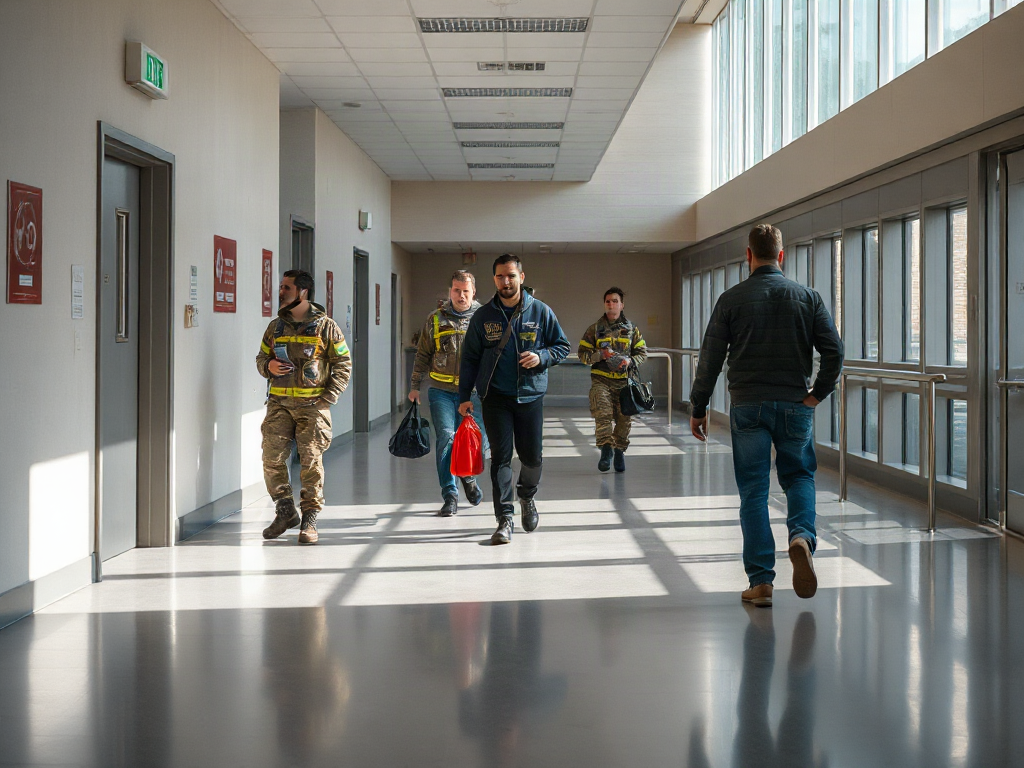
Set Exercise Objectives Before Sounding the Alarm
A useful evacuation exercise tests a defined capability, not merely whether people can leave a building. The objective might be recognizing the alarm, using an alternate exit, assisting a mobility-limited occupant, reporting to an assembly area, or reconciling a visitor list. A drill that attempts to test every part of the plan at once can produce plenty of activity but little diagnostic value.
Choose objectives from the hazards, occupants, and physical layout that shape the actual evacuation. A small household may need to practice leaving bedrooms in darkness and meeting outside without reentering for pets or belongings. A workplace may need to test floor sweeps, contractor accountability, and communication between separated assembly areas. A community facility may have to account for children, older adults, language barriers, or people unfamiliar with the exits.
Write down what acceptable performance looks like before the exercise. Timing can matter, but elapsed time should not become the sole measure. A fast evacuation involving a blocked doorway, an unaccounted visitor, or unsafe assistance is not a good result. Better measures include whether participants recognized the signal, selected a safe route, closed doors when appropriate, avoided elevators unless the plan specifically permits their use, reached the assigned location, and reported missing people without going back inside.
A compact pre-drill check should confirm:
- Scope: which area, shift, household members, or occupant groups will participate.
- Objective: the specific behavior or plan component under examination.
- Safety controls: who may stop the exercise and how real emergencies will be distinguished.
- Observers: where they will stand and what they will record.
- Completion: how accountability and the all-clear will be communicated.
The common mistake is scheduling a drill because a calendar says one is due, then treating participation as proof of readiness. A sharper approach links each session to a known vulnerability. Use an Emergency evacuation plan training exercises review to select one or two observable outcomes that can lead to a concrete correction.
Build Exercises From Walkthroughs to Disrupted Routes
Exercise difficulty should increase only after participants can perform the basic route and accountability process correctly. An announced walkthrough lets people see alarm devices, exits, outdoor meeting points, refuge locations where applicable, and the person responsible for head counts. It is especially appropriate for new occupants, children, visitors who regularly use the site, and anyone assigned an assistance role.
The next stage is an announced functional drill. Participants respond to the normal signal and carry out their assignments while observers record behavior. Once the routine is reliable, a later exercise can introduce one controlled complication, such as a sign indicating that the preferred corridor is unavailable. That change tests whether people know an alternate route rather than simply following the person ahead.
Consider an office where nearly everyone habitually uses the main stairwell. During a controlled exercise, an observer marks that stairwell unavailable before anyone enters it. The useful question is not whether employees finish within a preset minute count; it is whether they pause safely, identify the secondary stair, communicate the change, and avoid moving against the flow. If people gather around the blocked entrance waiting for instructions, the plan or route orientation needs work.
Unannounced drills may reveal natural behavior, but they carry greater operational and safety costs. They can be unsuitable where surprise could endanger occupants, interrupt critical procedures, trigger harmful stress, or be confused with a real alarm. Exercise planners should coordinate with responsible site leadership and any relevant safety personnel before changing the degree of notice. Simulated smoke, locked exits, or physical obstructions should never create actual exposure or impede a usable escape path.
A weak assumption is that realism always produces better training. Realism is valuable only when it clarifies decisions without introducing uncontrolled risk. Discussion-based scenarios can examine severe conditions that would be unsafe to stage, while movement drills are better for testing routes, alarms, assembly, and accountability. Mature Emergency evacuation plan training exercises use both formats rather than forcing every hazard into a live drill.
Test Communication, Assistance, and Accountability
Evacuation depends on information moving accurately before, during, and after people leave. Participants need to recognize the signal, understand whether it means evacuation or another protective action, and know where official updates will come from. Alarm audibility should be considered alongside visual or other notification methods needed by the occupants and setting.
Assistance arrangements require more than naming a helper on paper. The exercise should examine whether the designated people are present, whether backups understand the task, and whether the route works for the person receiving assistance. A plan built around one employee, neighbor, or family member can fail when that person is absent. Individual needs also change, so arrangements should be confirmed respectfully rather than assumed.
Accountability begins before the alarm. Workplaces may rely on current rosters, visitor logs, sign-in systems, or supervisor reports; households can use a fixed outdoor meeting place and a simple verbal count. The chosen method must remain available after leaving. A digital list that only one person can access from a desktop computer is fragile, while several uncontrolled paper lists can create conflicting totals. The practical choice depends on occupancy, privacy requirements, normal operations, and whether connectivity may be unavailable.
For example, a community event may have registered attendees, walk-ins, volunteers, and vendors. Counting only registered guests could produce false confidence. During the exercise, each group needs an identified reporting path, and the coordinator needs a way to flag discrepancies without sending volunteers back inside. Missing-person information should be passed to emergency responders or the authority directing the incident, not investigated through unauthorized reentry.
Assembly areas also deserve testing. They should be far enough from the hazard, access routes, and response activity while remaining practical for the occupants. Weather, traffic, security concerns, and the possibility of smoke or changing wind may make a secondary location necessary. A drill is failing if people disperse, leave without reporting, block arriving responders, or cannot hear instructions. Those behaviors usually indicate unclear expectations or a poorly chosen location rather than simple participant carelessness.
Observe Performance Without Creating New Hazards
Observers should capture decisions and conditions, not interfere with the evacuation unless safety requires it. Place them near route junctions, exits, stairs, assembly points, and accountability stations. Each observer should have a narrow assignment so that notes distinguish direct observation from assumption. A timestamp alone cannot explain why movement slowed or why one group chose another exit.
Useful observations include when the signal became noticeable, where hesitation occurred, whether doors or corridors became congested, how route changes were communicated, and when accountability was completed. Record environmental details that affect interpretation, such as a delivery obstructing visibility, a loud machine masking the alarm, or rain causing people to abandon the assembly location. Do not record unnecessary personal details in widely shared notes.
Safety authority must be explicit. One coordinator should be able to pause or terminate the drill, and everyone managing it should know the stop signal. If a real fire, medical event, severe weather warning, or other emergency develops, the simulation ends and actual procedures take priority. Exercise communications should prevent a scripted message from being mistaken for verified incident information.
Physical speed is often misread as competence. Running can cause falls, passing slower occupants can create bottlenecks, and pressure to beat a previous time can discourage accurate head counts. Compare performance against safe execution and the stated objective, not against an arbitrary record. Where local rules, fire codes, lease conditions, or organizational policies apply, the exercise must be aligned with the responsible authorities rather than relying on a generic drill template.
Signs that the method is working include independent use of alternate routes, calm reporting of missing people, successful use of backup assistance assignments, and fewer repeated errors in later exercises. Warning signs include observers coaching every decision, participants treating blocked routes as jokes, the same accountability discrepancy recurring, or leaders dismissing problems because the total time improved. Those signals indicate that the exercise design or follow-through needs correction.
Turn Drill Findings Into Plan Corrections
A drill creates value when observations become assigned changes. Hold a short participant debrief promptly, while route choices and communication problems are still fresh. Ask what signal people perceived, what they expected to happen, where they hesitated, and what made the written procedure hard to follow. Separate facts from interpretations; “three visitors were absent from the count” is more actionable than “accountability was confusing.”
Prioritize findings by consequence and recurrence. An exit that cannot be used, an alarm that is not perceived in a work area, or a missing assistance arrangement deserves attention before cosmetic signage preferences. Some corrections can be immediate, such as updating a roster or moving an assembly-area marker. Others may require property management, qualified safety professionals, accessibility input, or the authority responsible for the facility.
Assign every accepted action to a named role and set a completion date. Then decide how it will be verified. Reprinting a plan does not prove that occupants understand a changed route; a focused follow-up walkthrough may be needed. Equipment, alarm, access, or building-system concerns should be assessed and corrected by appropriately qualified people rather than improvised during the next drill.
Maintain a simple record of the exercise date, participants or areas covered, objectives, observed conditions, corrective actions, owners, and verification status. Avoid treating the record as the outcome itself. A polished report with unresolved high-consequence findings represents documentation, not readiness.
The frequent failure mode is repeating the same full-scale drill without isolating the weakness found previously. If accountability broke down, the next session can test rosters and assembly reporting before another building-wide movement exercise. If people missed the alternate exit, conduct route orientation and then retest that decision. This targeted cycle makes Emergency evacuation plan training exercises a method for improving the plan instead of a recurring performance for observers.
Frequently Asked Questions
How often should an evacuation exercise be conducted?
Frequency should reflect applicable requirements, occupant turnover, site hazards, and previous results. Add a focused exercise after material changes to routes, occupancy, alarms, assembly areas, or assigned responsibilities.
Should evacuation drills be announced?
Start with announced walkthroughs and drills when people are learning procedures. Less notice may later test routine response, but surprise should not override safety, accessibility, operational, or trauma-related concerns.
Is evacuation time the best measure of success?
No. Track safe route use, alarm recognition, assistance, communication, and complete accountability alongside time. A faster result is poor progress if it introduces unsafe movement or leaves someone unaccounted for.
What should happen if the primary exit is unavailable?
Participants should use a preidentified safe alternative rather than wait at or approach the affected route. Test this with a clearly simulated closure that never physically blocks a required exit.
Who should evaluate an evacuation exercise?
Use coordinators and observers who understand the plan, site, and exercise objective. Building systems, accessibility, code, or technical safety issues may require review by the responsible authority or a qualified professional.
Conclusion
Effective evacuation practice moves from orientation to controlled complications, with each exercise tied to an observable capability. Prioritize safe route selection, reliable assistance, clear communication, and accurate accountability before trying to reduce elapsed time. Observers should document where decisions broke down and why, while coordinators preserve the ability to stop the drill if actual danger appears.
The next step is to select one weakness in the current arrangement and design a bounded exercise around it. Define the expected behavior, assign observers, confirm safety controls, and decide how findings will be corrected. Afterward, give each accepted action an owner and verification method. Rehearse the corrected element before adding greater difficulty; repeated full evacuations are less useful when the underlying fault remains untouched.