
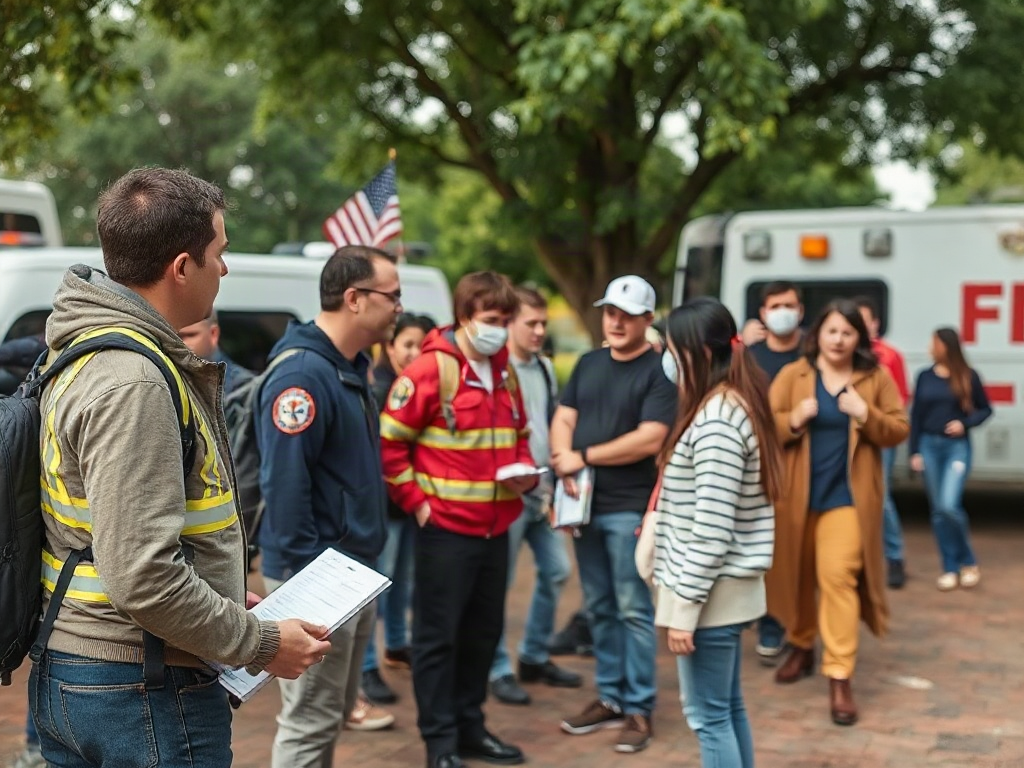
A useful emergency preparedness activity for community groups is a 60-minute scenario drill that assigns participants communication, accountability, access, and resource roles before presenting a realistic local disruption. The group should practice checking attendance, sharing verified information, assisting people with access or functional needs, and choosing between sheltering and relocation. Observers record delays, unclear decisions, and failed communication methods rather than judging individual performance. A short debrief then converts those findings into named corrective actions, responsible owners, and target dates, giving the community a practical improvement plan instead of a one-time discussion.
Choose a Scenario the Group Can Actually Use
The best exercise scenario reflects a disruption the community could plausibly face and a decision its members may need to make together. A neighborhood association might simulate an extended power outage during extreme heat, while a faith community could practice accounting for people after a building evacuation. A civic club that operates a meeting hall may get more value from a severe-weather shelter exercise than from an elaborate disaster simulation involving agencies it does not control.
Keep the scenario narrow enough to expose decisions within an hour. “A major disaster has occurred” gives participants little operational direction. “Electricity has been out for four hours, mobile service is intermittent, and the cooling center two miles away is open” creates specific questions: Who needs a welfare check? Which information is confirmed? Can members travel safely? Who has mobility, language, medical-device, or transportation needs? The details should create choices without scripting the answers.
Exercise design also needs a clear boundary between group responsibilities and professional response. Participants can practice notification, accountability, basic first aid within their training, and referral to public services. They should not imitate structural entry, utility repair, medical diagnosis, traffic control, or other hazardous duties. Calling emergency services, following official instructions, and staying out of unsafe areas are valid exercise decisions—not signs that the group failed.
A practical scenario statement should identify the location, time, immediate conditions, unavailable services, and one developing complication. For example, a community center loses power on a hot afternoon while 35 people are present. Ten minutes later, the facilitator reports that the usual exit is blocked and one attendee cannot use stairs. That complication tests whether the group knows an accessible alternate route rather than merely recognizing the need to leave.
A common mistake is selecting a dramatic event that overwhelms the group’s actual authority. Complex scenarios may generate energetic discussion but little transferable learning. For a first Emergency preparedness activity for community groups, choose one location, one operational period, and three or four decisions. More advanced groups can later add missing leaders, damaged facilities, conflicting reports, or a second operational site.
Prepare Roles, Materials, and Safety Boundaries
Good preparation gives participants enough structure to act without revealing the expected solution. Name a facilitator who controls the scenario, a timekeeper, and at least one observer who does not make decisions for the group. Everyone else should receive a functional assignment tied to the community’s real capabilities. Useful assignments include group coordination, member accountability, communications, accessibility support, facility checks from a safe location, and resource tracking.
Roles should have backups because the usual leader may be absent during an actual disruption. Pairing a primary and alternate also reveals whether knowledge is concentrated in one person. If only the association president can access the contact list or only one volunteer knows where the battery radio is stored, the drill has already identified a fragile dependency. Access to sensitive contact details should remain limited, and exercise copies should be collected or securely handled afterward.
Prepare a small exercise packet rather than a thick manual. It can include a participant roster using exercise-safe information, a site map, blank message forms, role cards, and a page for recording decisions. Mark all simulated messages clearly so no one mistakes them for a real warning. Participants may use their normal radios, phone trees, group messaging systems, printed lists, or runners, but they should not contact emergency dispatchers merely to test the scenario.
Before starting, state the safety rules in plain language. Real emergencies override the exercise. No participant should enter a restricted area, move heavy objects, climb, handle live utilities, or perform care beyond their training. Participation should also accommodate mobility, sensory, cognitive, language, and health-related needs. Someone who cannot perform a physical task can serve as a communicator, recorder, observer, or decision-maker rather than being excluded.
Use this compact readiness check before the session:
- Objective: Identify one or two abilities being tested, such as accounting for members and distributing verified updates.
- People: Assign a facilitator, observers, role holders, and alternates.
- Materials: Prepare maps, rosters, role cards, message forms, and visible “exercise only” labels.
- Boundaries: Explain prohibited actions, privacy controls, and how to stop the drill.
- Debrief: Reserve at least 15 minutes and name someone to document improvements.
The main preparation failure is confusing equipment display with capability. A table covered with radios and first-aid kits does not show that people can communicate under pressure or locate supplies in low light. Test ordinary procedures with the resources the group truly maintains. If the activity requires borrowed gear, ideal attendance, or an organizer feeding every answer, it is demonstrating a special event rather than community readiness.
Run the 60-Minute Community Drill
A disciplined timeline keeps the exercise active while leaving enough room for reflection. Use the first five minutes for safety instructions, objectives, and role assignments. Spend approximately 30 minutes on the scenario, introduce one or two complications during that period, and preserve the final 20 to 25 minutes for immediate observations and corrective actions. Facilitators should adjust the pace if a safety concern, accessibility issue, or genuine emergency arises.
Open with a factual situation report rather than a long narrative. Tell participants what has happened, which services are affected, what official information is available, and what remains unknown. The group should then establish who is coordinating, account for participants, identify urgent needs, and select a reliable method for sharing updates. Observers should note elapsed time and visible actions. They should not quietly solve problems or penalize people for taking a different but safe approach.
Complications, sometimes called scenario updates, should test the stated objective. If the goal is resilient communication, announce that mobile data has failed and ask the group to continue. If the goal is inclusive evacuation, report that a participant needs an accessible route and that the nearest exit cannot be used. Avoid piling on unrelated injuries, weather changes, missing children, and building damage at once. Too many problems make it impossible to determine which process worked and which one failed.
Consider a neighborhood power-outage example. The coordinator receives an update that a nearby cooling location is operating, but the message comes from an unverified social account. The communications lead checks an official local source before the group circulates the address. Meanwhile, accountability volunteers discover that two residents who normally need transportation have not replied. Rather than promising rescue, the group follows its established welfare-check procedure and identifies the point at which public safety or social services should be contacted.
Signs the exercise is working include concise status updates, visible tracking of who has been contacted, clear handoffs, alternate communication methods, and decisions tied to verified conditions. Warning signs include several people issuing instructions, private information being read aloud unnecessarily, participants acting on rumors, or no one documenting decisions. Silence can also reveal confusion rather than calm; the facilitator may ask, “Who currently has coordination responsibility?” without telling the group whom to select.
The facilitator should pause the activity if participants attempt an unsafe action or if the scenario becomes emotionally distressing. Otherwise, allow manageable mistakes to continue long enough for their consequences to become visible. A delayed roster check teaches more when participants notice that nobody can confirm who remains in the building. The aim of an Emergency preparedness activity for community groups is not a flawless performance. It is observable evidence about procedures that will need to function without coaching.
Debrief the Exercise and Correct Weak Points
The debrief determines whether the drill produces improvement or becomes a memorable meeting with no lasting effect. Begin immediately, while decisions and communication gaps remain fresh. Ask participants what they expected to happen, what actually happened, and what made the difference. Observers should report behavior they saw—such as a six-minute delay in locating the roster—rather than assigning blame or speculating about a person’s motives.
Discuss strengths before deficiencies, but require evidence for both. “Communication was good” is too vague to preserve. “The radio operator repeated the destination and received confirmation from both teams” identifies a practice worth retaining. Likewise, replace “the evacuation was disorganized” with a precise finding: participants reached the alternate door, but no one checked whether the route was accessible or whether all rooms had been cleared.
Sort findings by consequence and effort. A missing method for accounting for people is more urgent than inconsistent formatting on a supply sheet. A contact list that can be corrected during the next meeting should not remain open for months. Larger issues, such as modifying an accessible route or arranging backup power for essential communications, may require authorization, funding, property-owner involvement, or professional assessment. Recording those constraints prevents the group from pretending that every weakness has a quick volunteer solution.
Each corrective action needs four elements: a specific change, a named owner, a target date, and a way to verify completion. “Improve communications” is not actionable. “The communications coordinator will print two updated call-tree copies, store them in approved locations, and test the alternate notification method at next month’s meeting” can be checked. Protect personal data when updating rosters, and obtain appropriate permission before sharing names, phone numbers, health details, or assistance needs.
Repeat only the part that failed rather than rerunning the full hour immediately. If conflicting leadership caused delay, conduct a ten-minute role-transfer exercise. If messages were distorted, practice sending and confirming a short situation report. A later full drill can determine whether separate corrections work together. This progression costs less time and gives quieter or newer members a chance to build competence before a more demanding scenario.
The clearest evidence of progress appears in changed behavior: alternates can find the materials, messages reach the intended recipients, accountability records stay current, and participants know when to defer to official responders. Repeated confusion about the same task indicates that the correction was unclear, inaccessible, or never implemented. Document the result, revise the procedure, and schedule the next Emergency preparedness activity for community groups around the unresolved weakness rather than choosing a new theme for variety.
Frequently Asked Questions
How many people are needed for a community preparedness drill?
Six to twelve participants can test coordination, communication, and accountability effectively. Larger groups should use small functional teams and additional observers so everyone has a defined role.
Should emergency services participate in the activity?
Invite local emergency management or public safety representatives when available, but do not make their attendance a requirement. Never contact emergency dispatch during a simulation unless an actual emergency occurs.
What scenario works best for a first exercise?
Choose one familiar location and a plausible disruption such as a power outage, severe-weather warning, or blocked exit. Test only two capabilities, such as notification and accountability.
How often should a community group conduct a drill?
Schedule exercises often enough to test staff or volunteer turnover, updated contact information, and corrected procedures. Short practice sessions between larger drills can address specific weaknesses without exhausting participants.
How can the activity include people with disabilities?
Ask participants what support and communication formats they prefer, use accessible locations and routes, and offer meaningful physical and nonphysical roles. Do not assume a diagnosis determines what assistance someone needs.
Conclusion
A productive community exercise tests a small number of decisions under believable conditions and turns observed weaknesses into assigned work. Begin with a local scenario, define safe limits, distribute functional roles with alternates, and let participants use the communication methods and materials they would actually have. During the drill, record what people do rather than what planners hoped they would do.
The next step is to choose one location and two capabilities for a 60-minute session. Prepare a brief scenario, roster, map, role cards, and exercise-only messages, then reserve adequate time for the debrief. Finish by assigning owners and dates to the most consequential corrections. A shorter follow-up can verify individual fixes before the group attempts a more complex event.