
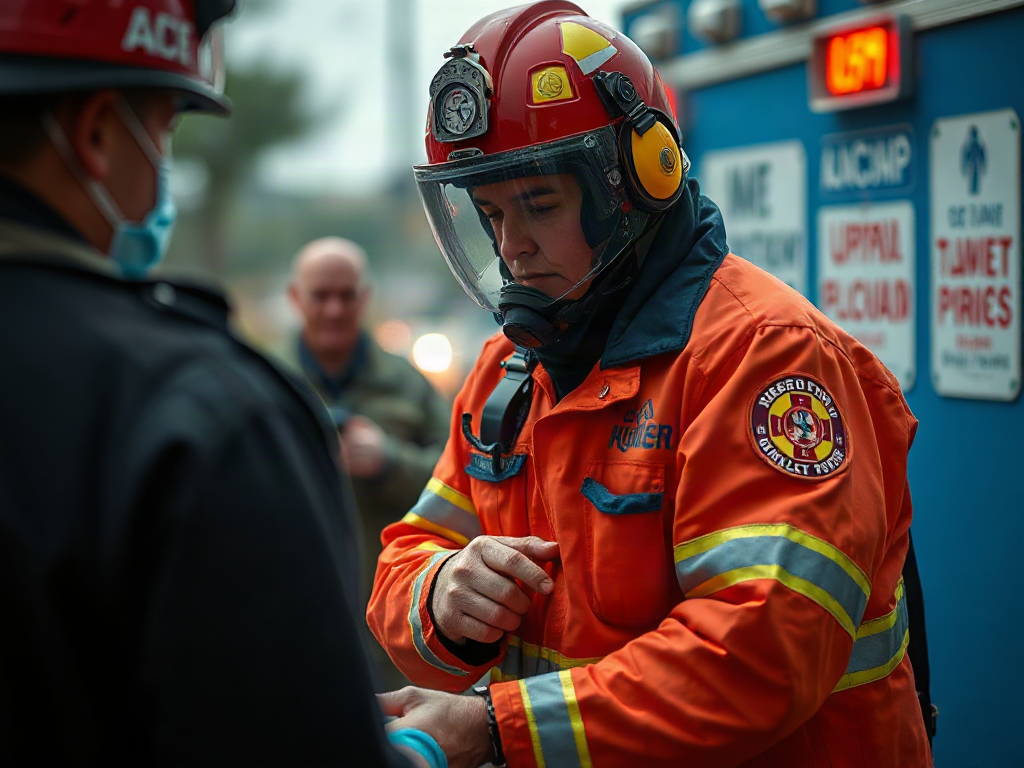
An effective injury emergency action plan assigns response roles, defines first actions, and establishes a clear handoff to emergency medical services. It should tell responders who assesses scene hazards, who calls 911, who retrieves first-aid equipment, and who meets arriving personnel. The plan must also address severe bleeding, breathing problems, suspected spinal injury, evacuation routes, location details, and documentation without encouraging care beyond the responder’s training. Practice should confirm that people can find supplies, communicate the exact location, and perform their roles under pressure rather than merely recite written instructions.
Define Activation Thresholds and Immediate Priorities
A usable plan distinguishes a minor injury from a potentially life-threatening event before anyone is forced to make that distinction under stress. Activation criteria should be written in observable terms: uncontrolled or severe bleeding, absent or abnormal breathing, loss of consciousness, a seizure, chest pain, signs of stroke, a severe allergic reaction, major burns, or a suspected head, neck, or spinal injury. When the severity is uncertain, calling emergency services is generally safer than delaying while untrained responders debate a diagnosis.
The first responder’s initial job is not to identify every injury. It is to check whether the scene is safe, determine whether the person is responsive and breathing normally, call for appropriate help, and provide care within current training. A damaged electrical cord, moving machinery, traffic, fire, unstable debris, or violent behavior can turn one casualty into several. The plan should explicitly state that responders do not enter an unsafe area unless they are trained, equipped, and authorized to manage that hazard.
Priorities should follow the threats that can cause rapid deterioration. Severe external bleeding may require firm direct pressure and, when indicated, a commercially manufactured tourniquet used by someone who understands its application. An unresponsive person who is not breathing normally may need CPR and an automated external defibrillator. A conscious person with a suspected spinal injury generally should not be moved unless remaining in place exposes the person to a more immediate danger. These actions are not interchangeable; the observed condition determines the response.
Consider a fall from a ladder in a workshop. A weak plan tells someone to “provide first aid.” A functional plan directs one person to stop nearby equipment, another to call 911 with the correct entrance and access instructions, and a trained responder to assess breathing and serious bleeding without unnecessarily moving the injured person. If the person is beneath an unstable load, hazard control may take priority over close contact.
A compact activation sequence can keep the opening minutes focused:
- Protect: Identify immediate hazards and use appropriate protective barriers.
- Assess: Check responsiveness, normal breathing, and obvious life-threatening bleeding.
- Alert: Call 911 or the applicable local emergency number and send someone to guide responders.
- Assist: Give only the care supported by the responder’s training and available equipment.
The common failure is treating the written procedure as permission to exceed one’s competence. An action plan organizes qualified help; it does not turn an untrained person into a clinician. Review Injury emergency action plan essentials whenever the site, staffing, hazards, or available medical resources change.
Assign Roles That Work Under Pressure
Named responsibilities reduce duplicated effort and unattended tasks. At minimum, the plan should identify an incident lead, a caller, a first-aid responder, an equipment runner, and a person who meets emergency personnel. In a small household or work crew, one individual may hold several roles, but the order of those duties must be explicit. Calling for advanced help should not wait until every other task is complete.
The caller needs more than an instruction to dial 911. A concise call script should include the street address or precise location, the nature of the injury, the number of injured people, known hazards, the caller’s telephone number, and the best access point. The dispatcher may give instructions or ask the caller to stay on the line. Someone should therefore be prepared to use speakerphone while another trained person provides care, provided doing so does not interfere with safety.
Access duties are especially important at farms, camps, warehouses, apartment complexes, and remote properties. A street address may lead responders to a locked gate or the wrong side of a large site. Record gate codes, building names, floor numbers, trail markers, coordinates where reliable, and landmarks that remain visible at night or in poor weather. The designated guide should carry a phone and, when safe, wait where arriving personnel can see them.
For example, during a youth activity on a large field, the nearest adult may begin assessment while a second adult calls emergency services. A third retrieves the first-aid kit and AED, and a fourth sends bystanders away from the access lane. If every adult crowds around the injured participant, no one may notice that the ambulance entrance is chained. Role separation solves an operational problem, not merely an administrative one.
Alternates are necessary because the primary responder may be absent, injured, or directly involved in the incident. Assign roles by position as well as by name, such as “shift supervisor” or “front desk attendant,” and keep an updated contact roster. Children, visitors, temporary staff, and people with limited mobility may require specific assistance, but private health information should be shared only as needed and handled according to applicable policies.
A frequent mistake is assigning a medical role to the most senior person rather than the person with current skills. Leadership authority and first-aid competence are different. Confirm who has current CPR, AED, first-aid, or bleeding-control training, then position equipment and backup personnel around actual coverage. The role structure is working when every essential task has an owner and no critical duty depends on one irreplaceable person.
Match Equipment and Location Information to the Setting
Supplies should reflect credible injuries at the specific location, not an oversized collection of unfamiliar products. A basic response station commonly needs protective gloves, dressings, gauze, medical tape, a CPR barrier, an instant cold pack, trauma shears, and clear instructions. Settings with machinery, glass, cutting tools, or long response times may justify dedicated bleeding-control supplies. An AED should be accessible where cardiac emergencies are plausible and where trained or willing responders can retrieve it quickly.
Accessibility matters as much as inventory. A locked cabinet, an unmarked storage bin, or a kit kept in a vehicle that is routinely off-site creates false readiness. Mark supply locations, keep routes unobstructed, and ensure that people can reach equipment during the hours the site is occupied. If supplies may be exposed to moisture, dust, heat, freezing temperatures, or tampering, use suitable storage without making access needlessly difficult.
Inspection should cover more than expiration dates. Check packaging integrity, depleted quantities, battery status where applicable, legible labels, and whether specialty items still match responder training. Prescription medication ordinarily belongs to the person for whom it was prescribed and should not be treated as a general first-aid supply. The plan should avoid improvised treatments or medications that require clinical judgment unless qualified personnel and an appropriate protocol are present.
A remote cabin illustrates the tradeoff between more equipment and more capability. Extra dressings, blankets, communication backups, and written coordinates may be useful when ambulance arrival will take longer. Advanced airway devices or surgical tools, however, add little value without the training and authorization to use them. In remote settings, early communication, accurate location data, weather awareness, and a realistic evacuation decision may matter more than carrying complex gear.
Post the address and location instructions beside fixed phones, kits, and radios. Mobile callers under stress may know the property but forget a road number, unit designation, or gate code. Where cellular service is unreliable, identify tested alternatives such as a landline, radio procedure, or appropriate satellite communication device. A communication backup is credible only after someone has tested coverage, power requirements, contact procedures, and the view of the sky where relevant.
The recurring failure mode is purchasing supplies without integrating them into the response. Connect each item to a trained user, an inspection interval, and a credible injury. A practical Injury emergency action plan essentials review should ask three questions: Can responders find it, is it ready to use, and does anyone know how to use it safely?
Practice the Response, Handoff, and Follow-Up
Exercises reveal delays that a written review cannot expose. A short scenario can test whether someone recognizes the activation threshold, calls from the actual location, retrieves equipment, clears the access route, and transfers useful information to arriving professionals. The drill should measure actions and obstacles rather than reward memorized wording. A person who can describe the plan but cannot locate the AED has not demonstrated operational readiness.
Use plausible scenarios tied to the setting. A household might practice a garage laceration while one adult is away. A workshop could test a hand injury near energized equipment. A hiking group could rehearse a fall where cellular coverage is intermittent. Do not simulate dangerous physical actions, apply real tourniquets tightly to participants, or delay an actual emergency for the sake of following a drill script. Training props and verbalized actions can test coordination without creating injury.
The handoff to emergency medical personnel should be brief and factual. Report what happened, when it happened, changes in responsiveness or breathing, major bleeding, relevant known medical information, and care already provided. Preserve medication containers or product labels when poisoning or exposure may be involved, but do not endanger anyone to retrieve them. One person should speak for the group so responders are not forced to reconcile several conflicting accounts.
After an incident, replace opened supplies, document required facts, and review the response while details are fresh. Documentation may include the time the injury was discovered, who was notified, observed conditions, care provided, and when emergency personnel assumed responsibility. Avoid speculation, blame, or an amateur diagnosis. Organizations should follow their own reporting requirements and applicable rules for privacy, workplace incidents, safeguarding, or notification.
A useful debrief separates plan defects from individual mistakes. If the caller gave the wrong entrance because the posted map was outdated, correcting the map is more valuable than simply telling the caller to do better. If nobody retrieved the kit because two people assumed the other had done it, the role assignment needs clearer confirmation. If responders could not hear each other near machinery, the communication method needs revision.
Signs of a functioning plan include rapid recognition, an unambiguous call for help, equipment arriving with the appropriate responder, and a controlled access route. Warning signs include confusion over authority, missing supplies, an unattended caller, unsafe movement of the injured person, or conflicting directions. Schedule practice after staffing or layout changes and periodically enough that assigned people remember their duties. Update Injury emergency action plan essentials based on observed friction rather than assuming a completed form remains accurate.
Frequently Asked Questions
Who should activate an injury emergency action plan?
Anyone who observes a potentially serious injury should be authorized to call for help. The plan may name a lead responder, but it should not require waiting for a manager before contacting emergency services.
When should 911 be called for an injury?
Call for severe bleeding, abnormal or absent breathing, loss of consciousness, suspected stroke or spinal injury, major burns, severe allergic reactions, or any condition that appears life-threatening. Follow the dispatcher’s instructions.
How often should the plan be practiced?
Practice periodically and after meaningful changes to personnel, site access, hazards, communications, or equipment. The interval should reflect the setting’s risk and staff turnover rather than an arbitrary calendar date.
What information should be given to emergency medical services?
Provide the exact location, access instructions, injury mechanism, number of patients, observed condition, known hazards, and care already given. Answer questions directly and remain available unless the dispatcher says otherwise.
Should an injured person be moved?
Avoid unnecessary movement when head, neck, back, or major limb injury is suspected. Movement may be necessary if fire, traffic, structural instability, or another immediate threat makes the current location more dangerous.
Conclusion
A credible injury response depends on decisions made before the incident: which conditions trigger outside help, who performs each task, where supplies are stored, and how responders reach the exact location. Build the procedure around observable hazards and current training rather than assumed medical skill. Then test it from the place where an injury is likely to occur, using the phones, entrances, equipment, and personnel that would actually be available.
Correct practical failures immediately. Replace missing supplies, update access details, designate alternates, and retrain anyone whose role exceeds their competence. The next step is a short scenario drill followed by a factual debrief. If participants cannot summon help, retrieve equipment, protect the scene, and provide a clear handoff without confusion, the plan needs revision before it can be trusted.