
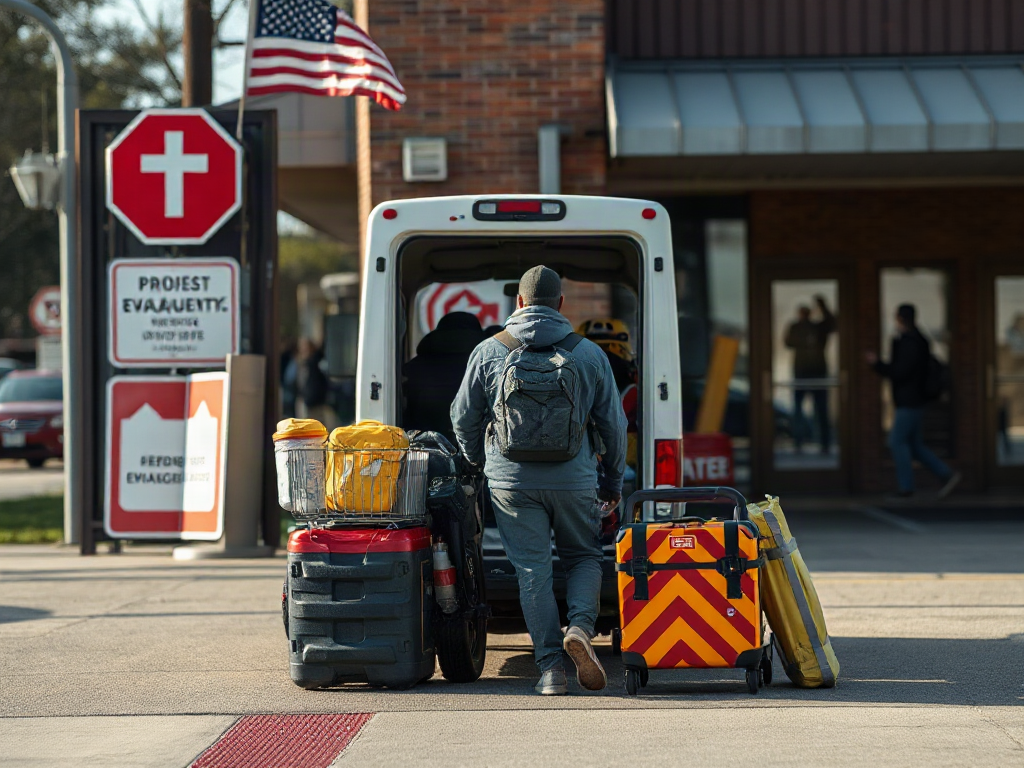
Injury or environmental emergency response steps begin with scene safety, rapid danger assessment, emergency notification, and care matched to the person’s condition and exposure. Move away from traffic, fire, electricity, unstable structures, contaminated air, or rising water before approaching, then check responsiveness, breathing, severe bleeding, heat or cold effects, and hazardous exposure. Call emergency services early when breathing is abnormal, bleeding cannot be controlled, consciousness changes, or the environment remains dangerous. Avoid moving a seriously injured person unless remaining in place creates greater risk, and do not enter a contaminated or confined area without suitable training and protection. Continue observation, provide only appropriate first aid, and give responders precise location and hazard details.
Make the Scene Safe Before Giving Aid
Scene safety determines whether a helper becomes a second casualty. Before touching an injured person, pause long enough to identify moving vehicles, live wires, fire, unstable debris, aggressive animals, chemical vapors, floodwater, falling objects, or poor visibility. An injury may be obvious, but the environmental hazard may be the factor that continues causing harm. The safest response may be to keep distance, warn others away, and call trained responders rather than attempt a rescue.
Use a simple outside-in assessment. Look at the ground, overhead area, nearby structures, air movement, and escape route. Do not rely on the absence of a strong odor; some dangerous gases have little warning smell, and a familiar smell can become difficult to notice after exposure. In traffic, stand where approaching drivers can see you and avoid placing yourself between vehicles. Near water, assume submerged debris, current, and unstable banks are present unless responders have confirmed otherwise.
Moving a person is a judgment call, not an automatic first step. If there is immediate fire, collapse, drowning, or active violence, relocation may be necessary. If the scene is stable, unnecessary movement can worsen a spinal, pelvic, or limb injury. A common mistake is rushing toward the casualty while carrying no way to summon help; another is entering a confined or contaminated space because the person appears close enough to reach. Call emergency services, provide the exact location, and describe the hazard before choosing a rescue action.
Practical Injury or environmental emergency response steps begin with a safe position for the helper. Keep bystanders back, use barriers where available, and avoid contact with blood or unknown substances. Gloves can reduce contact risk, but ordinary gloves do not make a chemical, smoke, or confined-space rescue safe. If the hazard cannot be controlled from outside, wait for personnel equipped and trained for that environment.
Sort the Problem: Injury, Exposure, or Both
Classifying the emergency helps determine what must happen first. A person may have a physical injury, an environmental illness, a toxic exposure, or several of these at once. A fall from a ladder can cause bleeding and heat stress; a vehicle crash can combine blunt trauma with fuel, smoke, or electrical hazards. Treat the immediate threat to life while gathering information that will guide professional care.
Check responsiveness and normal breathing, then look for severe bleeding. If the person is unresponsive and not breathing normally, emergency dispatch instructions and immediate resuscitation measures take priority. If there is major bleeding, apply firm direct pressure with a dressing or clean cloth when the scene allows. Do not waste time searching for a perfect medical kit. If a dressing becomes soaked, add material over it rather than repeatedly removing the original layer. A tourniquet should be used only when appropriate and according to current training or dispatcher guidance.
Environmental symptoms may be less dramatic than a wound but can deteriorate quickly. Confusion, unusual behavior, collapse, severe weakness, breathing difficulty, chest discomfort, uncontrolled shivering, hot dry skin, or inability to stay awake warrant urgent medical help. Ask what happened, when exposure began, whether the person was wearing protective equipment, and whether others nearby have similar symptoms. Those details can reveal a shared environmental cause rather than an isolated medical event.
Do not force food, drink, medication, or vomiting when the person is confused, unconscious, having trouble swallowing, or exposed to a suspected poison. Do not apply neutralizing chemicals to a skin exposure unless qualified guidance specifically directs it. For contamination, remove the person from the source when safe, avoid spreading the substance, and follow product-label or poison-control instructions. The weak assumption that every emergency is “just an injury” can delay decontamination and expose helpers.
Use Injury or environmental emergency response steps as a sequence of decisions: Is the scene safe? Is the person responsive and breathing normally? Is there life-threatening bleeding? Is there an ongoing exposure? What information will responders need? That sequence is more reliable than trying to identify a diagnosis at the scene.
Prioritize Immediate Care and Emergency Communication
Emergency communication should happen early when serious injury or dangerous exposure is possible. Tell the dispatcher the exact location first, then explain what happened, how many people are affected, the active hazard, and the person’s most serious signs. A rural driveway, trail junction, industrial area, or large building may require a landmark, access gate, floor, room, or GPS coordinates. Send a bystander to guide responders only when doing so does not leave the injured person alone.
While waiting, follow dispatcher instructions and continue observing the person. Keep an alert person in a position that supports comfortable breathing, but avoid moving someone with a possible serious injury unless the location itself is unsafe. Control visible bleeding, protect the person from rain or cold, and avoid crowding. A conscious person may provide useful information about allergies, medications, medical conditions, and the exposure substance, but do not delay urgent care for a complete history.
Priorities can change. A person who initially answers questions may become drowsy after smoke exposure, head trauma, heat illness, or blood loss. Recheck responsiveness and breathing when the situation changes. If breathing becomes abnormal or stops, begin the response directed by emergency dispatch. If vomiting occurs while the person is unconscious, follow dispatcher guidance about positioning and airway protection; do not blindly reach into the mouth.
One frequent failure is focusing on a visible wound while overlooking breathing difficulty or altered mental status. Another is giving responders a long narrative without the facts they need to act: current location, hazard, number of patients, consciousness, breathing, severe bleeding, and changes over time. The best handoff is concise and updated. Explain what was done, when it was done, and whether the person improved, worsened, or remained unchanged.
A compact priority list is useful under stress:
- Protect yourself and others from the active hazard.
- Call emergency services for life threats or unsafe conditions.
- Check responsiveness, normal breathing, and severe bleeding.
- Stop ongoing exposure only when the action is safe.
- Monitor changes and transfer clear information to responders.
Manage Heat, Cold, Water, Smoke, and Contamination
Environmental emergencies require both removal from the hazard and appropriate supportive care. Heat illness may follow exertion, high temperature, humidity, or inadequate fluid intake; cold injury may develop from wet clothing, wind, immersion, or prolonged inactivity. Smoke and combustion products can impair breathing even when skin burns are minor. Water incidents add drowning risk, hidden trauma, and hypothermia. The first action differs by hazard, so a single “cool everyone” or “warm everyone” rule is unsafe.
For heat-related illness, move the person to shade or a cooler location and remove excess outer clothing when safe. If the person is confused, collapsing, vomiting repeatedly, or unable to drink normally, treat the situation as urgent rather than relying on oral fluids. For cold exposure, move to shelter, replace wet layers with dry insulation when practical, and handle a person with suspected cold injury gently. Do not rub numb or frozen skin, and do not use intense direct heat that can burn damaged tissue.
After smoke exposure, fresh air is useful only if reaching it does not require passing through smoke or fire. Breathing difficulty, hoarseness, facial burns, persistent coughing, confusion, or worsening symptoms require emergency evaluation. In a water incident, do not create a second drowning by swimming into current or approaching unstable ice. Use a reach, throw, or other safer method from shore when possible, and wait for trained water rescuers if the person cannot be reached without entering the hazard.
Chemical exposure calls for source control and careful contamination management. Remove contaminated clothing when safe, keep the substance away from unaffected skin, and use copious water for many skin or eye exposures unless product instructions or professional guidance say otherwise. Avoid improvised neutralizers, ointments, and household cleaners. Bring the product container or its label information for responders without carrying a leaking container into a vehicle or occupied building.
Environmental care has tradeoffs: rapid removal may be lifesaving, while rough handling can worsen injury; cooling or warming may help, while extreme temperature applied too quickly can cause harm. The practical test is whether the person’s breathing, alertness, pain, skin condition, or ability to communicate is improving. If symptoms progress, treat that change as evidence that professional care is needed, not as a reason to try increasingly aggressive home measures.
Monitor, Transfer Care, and Improve Readiness
Observation continues after the immediate danger appears controlled. Shock, airway swelling, internal injury, heat illness, and toxic effects may become clearer over time. Keep the person with a responsible adult when possible, maintain a safe temperature, and watch for changes in breathing, alertness, skin color, pain, coordination, and ability to answer simple questions. A temporary improvement does not prove that a serious injury or exposure has resolved.
Prepare a concise handoff before responders arrive. Record the approximate time of the incident, the person’s initial condition, relevant exposure duration, first-aid actions, medications or substances involved, and any changes. Avoid moving evidence or contaminated materials unnecessarily, but take a photograph of a product label from a safe distance if that will help identify the substance. Do not make promises about recovery or encourage a person to drive themselves after fainting, confusion, significant injury, or hazardous exposure.
Households and workplaces should rehearse the decisions that are hardest to make under pressure: who calls, who meets responders, where the first-aid supplies are, how access is provided, and which hazards require evacuation rather than intervention. A kit should match the setting, but equipment cannot replace training. A flashlight, gloves, dressings, clean water, communication device, and written location details may be useful, while specialized rescue gear should be used only by people trained to use it.
After the event, review what failed without turning the review into blame. Was the location difficult to describe? Did anyone enter an unsafe area? Were gloves or clean water inaccessible? Did the group mistake a serious symptom for fatigue? These questions reveal practical improvements. More supplies may not solve a communication problem, and a longer checklist may not help if it cannot be read in darkness or stress. The most useful readiness measure is a short, practiced response that protects the helper, activates professional support, and preserves accurate information.
For broader household preparation, connect these decisions with Injury or environmental emergency response steps and keep local emergency numbers, poison-control guidance, workplace procedures, and evacuation routes available in more than one format.
Frequently Asked Questions
What should happen first at an injury scene?
Check whether the area is safe for you and the injured person. Identify active hazards, call emergency services when needed, and then assess responsiveness, breathing, and severe bleeding.
When should an injured person be moved?
Move the person only when remaining in place creates a greater immediate danger, such as fire, collapse, drowning, or active violence. Otherwise, unnecessary movement may worsen serious injuries.
How should a suspected chemical exposure be handled?
Stop contact with the source when safe, remove contaminated clothing if appropriate, rinse according to product guidance, and contact emergency services or poison-control professionals for specific instructions.
What environmental symptoms require urgent help?
Confusion, collapse, abnormal breathing, severe weakness, uncontrolled shivering, worsening heat symptoms, smoke-related breathing problems, or inability to stay awake require urgent medical attention.
What information should be given to responders?
Give the exact location, number of people affected, hazard type, time of incident or exposure, major symptoms, changes observed, and first-aid actions already taken.
Conclusion
Effective response to injury or environmental danger depends on sequence and judgment. Protect the helper first, identify the active hazard, summon professional help early for serious signs, and provide only care that is safe for the situation. Check breathing, responsiveness, and major bleeding before focusing on less urgent details. Heat, cold, smoke, water, and chemical exposures require hazard-specific actions; improvised treatment can create additional harm. Continue monitoring because a person who appears stable may deteriorate after trauma or exposure. Prepare by practicing location details, communication roles, evacuation choices, and basic first aid before an incident occurs. When uncertainty remains, keep distance from the hazard and follow emergency-dispatch instructions rather than taking an untrained rescue risk.