
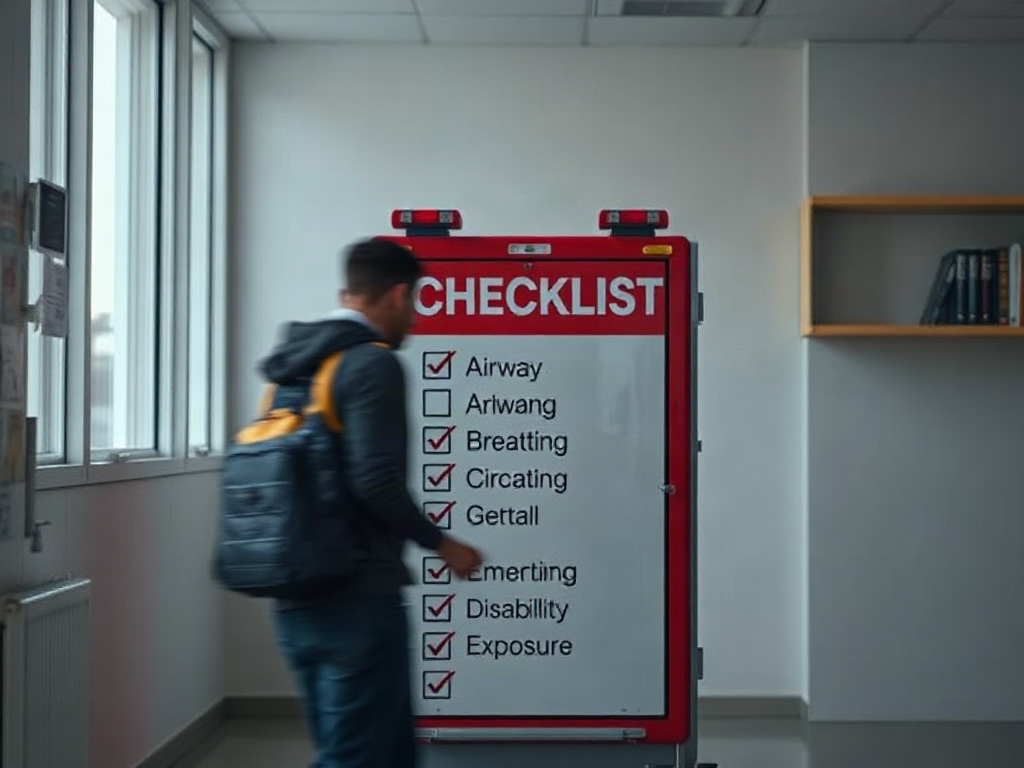
The ABCDE emergency checklist steps explained here provide a rapid order for assessing Airway, Breathing, Circulation, Disability, and Exposure while calling emergency services and treating immediate threats. Check whether the airway is open, confirm effective breathing, look for severe bleeding or poor circulation, assess responsiveness and obvious neurological change, then expose only what is necessary to find injuries while preventing heat loss. Reassess after every intervention because a person’s condition can deteriorate quickly. The sequence supports prioritization, not diagnosis, and it does not replace professional training or emergency dispatch instructions.
What you’ll learn
This guide covers the following practical points:
- Why the ABCDE Order Matters — The ABCDE sequence gives an emergency assessment a fixed priority: Airway, Breathing, Circulation, Disability, and Exposure.
- Airway and Breathing Checks — The airway check asks whether air can move into and out of the person’s lungs.
- Circulation and Immediate Threats — The circulation step looks for life-threatening bleeding, signs of shock, and evidence that blood is not reaching the body effectively.
- Disability, Exposure, and Reassessment — Disability is a focused neurological check rather than a full medical examination.
Why the ABCDE Order Matters
The ABCDE sequence gives an emergency assessment a fixed priority: Airway, Breathing, Circulation, Disability, and Exposure. It is designed for situations in which a person may be seriously ill or injured and the rescuer must identify threats that can become fatal quickly. The order is not a checklist to complete once and forget. It is a repeating cycle of observation, action, and reassessment while professional help is on the way.
Airway and breathing come before a detailed injury survey because oxygen cannot reach the body if air cannot enter the lungs or the lungs are not working effectively. Circulation follows because major bleeding and poor blood flow can cause rapid deterioration even when breathing appears normal. Disability then focuses on responsiveness and neurological warning signs, while Exposure allows the rescuer to find hidden injuries without unnecessarily removing clothing or causing heat loss.
A useful practical distinction is the difference between an assessment and a diagnosis. A bystander may notice noisy breathing, pale skin, confusion, or uncontrolled bleeding, but those observations do not identify the underlying medical condition. Use the findings to choose an immediate protective action and communicate clearly with the dispatcher. If the person is unresponsive, not breathing normally, or has life-threatening bleeding, contact emergency services immediately and follow dispatcher instructions rather than delaying to complete every category.
Keep the ABCDE emergency checklist steps explained in mind as a priority ladder, not a substitute for first-aid training. A trained clinician may use more detailed measurements and interventions; a household responder should concentrate on scene safety, rapid recognition, basic first aid within training, and timely escalation.
Airway and Breathing Checks
The airway check asks whether air can move into and out of the person’s lungs. Look at the person, speak loudly, and assess whether they can answer coherently. A person who can speak in a normal voice is usually moving air at that moment, although this does not rule out serious illness. An unresponsive person requires immediate attention to airway patency and normal breathing.
Signs of airway trouble can include choking, abnormal gurgling, snoring-like sounds in an unconscious person, inability to speak, or visible obstruction. Do not blindly sweep inside the mouth, because a finger can push an object farther back. If a responsive adult or child is choking and cannot cough, speak, or breathe effectively, use the choking response appropriate to your training and local first-aid guidance. If the person becomes unresponsive, lower them safely and begin the emergency response directed by dispatch.
Breathing is more than noticing that the chest moves. Check for normal movement, effort, rate, and sound while avoiding a prolonged examination. Occasional gasps, known as agonal breathing, are not normal breathing and should not be treated as reassuring. Severe wheezing, blue or gray coloration, inability to speak in full phrases, or rapidly increasing effort are warning signs that require urgent emergency help.
A common mistake is spending too long searching for a pulse or trying to identify the exact respiratory cause before calling for help. The safer approach is to recognize abnormal breathing promptly, use the speaker function on the phone if possible, and follow dispatcher instructions. If the person is unconscious but breathing normally, protect the airway according to your training and monitor continuously; if breathing is absent or abnormal, begin the response you have been instructed to perform.
For a person with a possible spinal injury, avoid unnecessary movement, but do not allow fear of moving the neck to prevent airway support or resuscitation when those actions are required. Airway and breathing threats take priority over a perfect position.
Circulation and Immediate Threats
The circulation step looks for life-threatening bleeding, signs of shock, and evidence that blood is not reaching the body effectively. Severe external bleeding may be obvious, but it can also collect beneath clothing or come from an area partly hidden by furniture, equipment, or darkness. Once airway and breathing concerns are addressed, scan quickly for blood loss and apply firm direct pressure with a dressing, clean cloth, or gloved hand when appropriate.
Do not repeatedly lift the dressing to inspect the wound. Interrupting pressure can restart bleeding and remove early clotting. If blood soaks through, add material on top and continue pressure unless trained guidance directs another method. A commercial tourniquet may be appropriate for catastrophic limb bleeding when the responder has been trained to use one; improvised devices and uncertain placement can cause harm, so emergency dispatch guidance is valuable.
Other circulation clues include unusually pale, gray, cool, or clammy skin; weakness; faintness; confusion; and a rapid or weak pulse when a trained responder is checking it. These signs are not specific enough to establish a diagnosis, but they justify urgent professional assessment. Keep the person still, protect them from cold, and do not give food, drink, or medication to someone who may need urgent procedures or who cannot swallow safely.
Consider the tradeoff between a detailed body check and controlling an obvious threat. If a person has a spurting wound, the priority is effective pressure, not a complete history. If no major bleeding is visible, continue with the assessment while monitoring for changes. A frequent failure mode is treating a small-looking wound as harmless because the opening is narrow; bleeding severity depends on the damaged vessel and location, not only on wound size.
When communicating with emergency services, describe what you can observe: amount and location of bleeding, skin changes, responsiveness, breathing quality, and actions already taken. The checklist sequence is most useful when it produces clear information that responders can act on.
Disability, Exposure, and Reassessment
Disability is a focused neurological check rather than a full medical examination. Determine whether the person is alert, responds to speech, responds only to stimulation, or does not respond. Note sudden confusion, slurred speech, one-sided weakness, seizure activity, unequal movement, or a severe change from the person’s normal behavior. If the person has diabetes, prescribed rescue medication, or a known neurological condition, tell emergency services, but do not assume a familiar diagnosis explains every emergency.
Ask simple questions such as their name, location, and what happened if they are awake. Confused answers may indicate reduced oxygen delivery, head injury, stroke-like symptoms, intoxication, low blood sugar, or another problem. The purpose of the check is to identify deterioration and communicate it, not to label the cause. Never give oral food, drink, or medication to a drowsy or poorly coordinated person because swallowing may be unsafe.
Exposure means looking for injuries or illness that were missed during the first scan. Open or cut clothing only as necessary, preserve privacy, and inspect areas hidden by clothing when the situation warrants it. Look for burns, deformity, rash, penetrating injuries, swelling, and bleeding. Then cover the person promptly. A cold surface, wet clothing, or prolonged exposure can worsen distress and heat loss, while excessive covering can be problematic for someone who is overheating.
Reassessment connects every part of the sequence. After controlling bleeding, changing a position, or helping with a prescribed emergency device when trained, return to airway and breathing. A person who was talking may become less responsive; a wound that looked controlled may begin bleeding again. Write down or remember the time of major changes, what was observed, and what was done. This information can improve the handoff to arriving responders.
The practical balance is speed without tunnel vision. A rapid check is better than a slow inspection that delays emergency contact, but a single pass is not enough. Continue watching the person until trained help takes over, and do not leave an unstable person alone to retrieve supplies unless another responsible adult is monitoring them.
Common Mistakes and Practical Use
The ABCDE framework works best when paired with scene safety and early activation of emergency services. Before approaching, check for traffic, fire, electricity, violence, chemicals, unstable structures, or other hazards. A rescuer who becomes injured creates a second emergency. Use gloves or a barrier if available, but do not delay an urgent call because protective equipment is not immediately at hand.
Several weak assumptions make emergency checklists less effective. A conscious person is not necessarily stable, normal-looking skin does not rule out internal injury, and the absence of visible blood does not prove circulation is adequate. Conversely, a dramatic symptom should not prompt unsafe treatment outside the responder’s training. The goal is to identify immediate threats, provide basic aid, and transfer responsibility to professionals.
A compact working sequence is:
- Protect: make the scene as safe as reasonably possible and use barriers when available.
- Alert: call emergency services early, state the location, and use speakerphone if hands-on care is needed.
- Assess: move through Airway, Breathing, Circulation, Disability, and Exposure.
- Act: address the most urgent threat within your training and dispatcher guidance.
- Recheck: repeat the sequence after every significant change.
Practice matters because stress narrows attention and makes people forget steps they have only read once. A household can keep gloves, dressings, a flashlight, and emergency contact information together, while each adult learns how to call for help and describe a location. Supplies support action but do not replace training; a sophisticated kit is less useful than a responder who recognizes abnormal breathing and summons help promptly.
Use reputable first-aid instruction to learn techniques that require hands-on practice, such as CPR, choking response, bleeding control, and use of an automated external defibrillator. The ABCDE assessment provides structure, but local emergency dispatchers and trained medical personnel should guide decisions beyond basic first aid.
For hands-on skills and current response instructions, consult recognized first-aid and resuscitation organizations, local emergency services, or an accredited training provider. Official instruction is preferable to relying on a checklist alone, particularly for CPR, choking, severe bleeding, and situations involving children.
Frequently Asked Questions
What does ABCDE stand for in an emergency assessment?
It stands for Airway, Breathing, Circulation, Disability, and Exposure. The order helps identify immediate threats before less urgent details.
Should I complete the whole ABCDE sequence before calling emergency services?
No. Call immediately for unresponsiveness, abnormal breathing, severe bleeding, or another obvious emergency. Reassess while following dispatcher instructions.
What counts as abnormal breathing?
Gasping, irregular breaths, severe effort, inability to speak normally, or very poor air movement should be treated as abnormal and reported urgently.
Why is exposure included if the person already has an obvious injury?
Additional bleeding, burns, deformity, or injuries may be hidden by clothing. Expose only as needed, protect privacy, and prevent unnecessary heat loss.
Can the ABCDE checklist diagnose the person’s condition?
No. It organizes urgent observations and first actions; diagnosis and advanced treatment require qualified medical professionals.
Conclusion
ABCDE is most valuable when it keeps attention on threats that can worsen quickly. Make the scene safe, activate emergency services early, check airway and breathing before moving to circulation, then assess responsiveness and hidden injuries. Control severe bleeding, support breathing or resuscitation only within your training and dispatcher guidance, and repeat the assessment whenever the person changes. Avoid common errors such as delaying the call, giving fluids to someone with impaired consciousness, blindly searching the mouth, or leaving a deteriorating person unattended. A printed checklist can support memory, but practical first-aid training remains the better preparation. The next useful step is to learn CPR, choking response, and bleeding control from a recognized provider and to keep essential supplies accessible.