
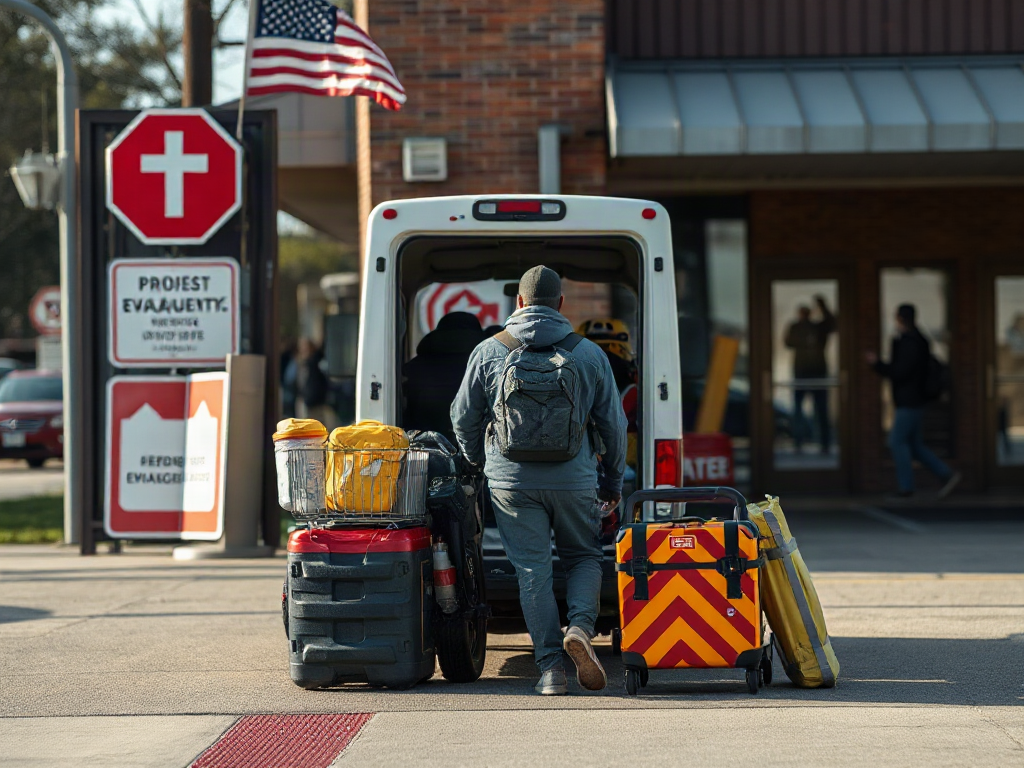
The purpose of a personal emergency evacuation plan is to turn an unexpected departure into a practiced sequence covering routes, contacts, transportation, and essential supplies. It reduces hesitation when smoke, flooding, wildfire, chemical release, or an official warning makes staying unsafe. A useful plan identifies more than one destination and route, accounts for children, older adults, disabilities, pets, and medication needs, and explains how household members will reconnect if separated. Its value depends on realistic details: printed directions when networks fail, a fuel and charging strategy, accessible exits, and regular updates after moves, road changes, or household changes. A plan is not a guarantee of safety; it is a decision aid that makes timely movement more likely.
What you’ll learn
This guide covers the following practical points:
- Why a Personal Evacuation Plan Matters — A personal evacuation plan converts general awareness into specific decisions that can be made under pressure.
- What a Workable Plan Must Contain — A workable plan names people, places, actions, and limits.
- Routes, Destinations, and Communication Choices — Route planning should account for changing conditions rather than treating one familiar road as permanent.
- Testing, Updating, and Avoiding Failure — A plan becomes reliable through small, realistic tests.
Why a Personal Evacuation Plan Matters
A personal evacuation plan converts general awareness into specific decisions that can be made under pressure. During a fast-moving hazard, people may have incomplete information, blocked roads, limited phone service, or only minutes to collect what they need. A written plan gives household members a shared starting point instead of forcing them to negotiate every choice during the disruption.
The purpose is not to predict the exact disaster. It is to establish actions that remain useful across several hazards: leave when authorities direct evacuation, leave when conditions make the residence unsafe, choose a viable route, reach an agreed destination, and report status. The same structure may apply to a wildfire warning, a major storm, a gas leak, or a neighborhood power failure that affects medical equipment.
Planning also exposes constraints that are easy to miss. A route that works for a healthy adult may not work for someone using a wheelchair. A destination that accepts one household member may not accept a pet. A vehicle plan may fail if the driver is away, fuel stations are closed, or a child needs a specialized car seat. Writing these issues down makes them solvable before an emergency.
A weak assumption is that official warnings will provide every personal instruction. Public alerts may identify the hazard and evacuation area, but they cannot know which family member is home, which exit is accessible, or where medication is stored. Use official instructions as the controlling safety information, then use the personal plan to organize the household response. The related Purpose of a personal emergency evacuation plan is therefore practical: it closes the gap between public direction and individual action.
What a Workable Plan Must Contain
A workable plan names people, places, actions, and limits. It should identify household members, emergency contacts outside the immediate area, primary and alternate exits, transportation options, destinations, and a method for confirming that everyone is safe. Keep the wording simple enough for a teenager, visitor, or temporary caregiver to follow.
Start with the first decision point: what will cause the household to leave? Some events require following an evacuation order, while others require immediate movement away from an unsafe room or building. The plan should not encourage waiting for perfect certainty. It can state who checks official alerts, who assists a dependent person, and who collects the preselected essentials if time permits. No item should delay departure when conditions are deteriorating.
Account for different needs rather than creating a fictional average household. Include prescriptions, mobility devices, hearing or visual communication needs, infant supplies, pet carriers, service animals, important documents, and a way to maintain essential medical equipment. A person who relies on electricity should know the backup location and transportation arrangement before an outage or evacuation order occurs.
A compact household checklist may include:
- Two ways out of the home or building, with accessibility limitations noted.
- At least two destinations, such as a nearby safe location and an out-of-area contact or lodging option.
- One contact method that does not depend on every person calling at once.
- Transportation details, including who can drive, where keys are kept, and what happens if a vehicle is unavailable.
- A short departure kit stored where it can be reached without searching.
Do not confuse a long inventory with a strong plan. A three-page list of possessions can distract from the route, destination, and people who need assistance first. The practical test is whether a household member can locate the plan, understand the first move, and leave without improvising critical details.
Routes, Destinations, and Communication Choices
Route planning should account for changing conditions rather than treating one familiar road as permanent. Identify a primary route and at least one alternative, then note bridges, low-lying areas, narrow roads, tunnels, or intersections that could become unusable. A map saved on a phone is useful, but printed directions or a marked paper map provide a backup when batteries, cellular service, or internet access fail.
Choose destinations based on safety and suitability, not merely distance. A nearby location may be inaccessible because it lies in the same hazard area. A farther destination may be more practical if it offers shelter, accessible facilities, medication access, or a trusted contact. Ask whether the destination can accommodate pets, children, equipment, and the expected length of disruption. The best destination on an ordinary day may not be the best option during a regional evacuation.
Communication plans work better when they reduce congestion. Designate an out-of-area contact who can receive brief status messages, and agree on what a message means, such as “left home,” “at destination,” or “need assistance.” Text messaging may work when voice calls do not, but no single method should be treated as guaranteed. Household members should know when to stop trying to call and move to the agreed meeting point or contact sequence.
Consider a split-household scenario. One adult may be at work, another may be collecting a child, and a pet may be at home. A plan that says “meet at home” can fail if the home is inside the evacuation zone. A stronger arrangement names an initial meeting place outside the immediate hazard area and a second location farther away. It also states who is responsible for each dependent person without assuming that the usual caregiver will be available.
Review route information against official evacuation zones and local emergency-management instructions. The personal plan supplements those instructions; it never overrides a closure, shelter direction, or order to use a designated route. The personal evacuation plan should make official guidance easier to follow, not create a competing command system.
Testing, Updating, and Avoiding Failure
A plan becomes reliable through small, realistic tests. Walk the exits, drive the alternate route, locate the departure kit in low light, and verify that every household member knows the meeting points. A drill does not need to imitate a catastrophe. Its purpose is to reveal friction: a locked gate, an inaccessible stairway, a dead phone, an expired prescription, or uncertainty about who collects a child.
Test the parts most likely to fail under time pressure. Ask a household member who did not write the plan to explain the first three actions. Check whether printed directions are legible, whether vehicle fuel or charging arrangements are adequate for the intended route, and whether carriers or mobility equipment can be moved quickly. If the answer depends on one person, one key, or one vehicle, add a backup.
Plans also expire when circumstances change. Update them after a move, new job schedule, school change, new pet, medical change, vehicle replacement, road construction, or change in emergency contact. Confirm that phone numbers, addresses, access codes, and medication information remain accurate. Keep a paper copy in a known location and a digital copy where household members can reach it, while protecting sensitive personal information.
Common failure modes include packing too much, choosing a destination without confirming access, assuming everyone will receive the same alert, and delaying departure to retrieve nonessential property. Another mistake is practicing only the preferred route. Compare the plan with an alternative approach: sheltering may be safer for some hazards when authorities advise it, while evacuation is necessary for others. The decision should follow current official instructions and the conditions at the location, not a rigid rule written months earlier.
Use a brief review after each drill or real incident. Record what took too long, what information was missing, and which responsibility was unclear. Then change the plan itself rather than relying on memory. The plan’s purpose is fulfilled when it produces faster, clearer action under the household’s actual constraints.
For local evacuation zones, alert systems, shelter information, and hazard-specific instructions, consult your city or county emergency-management office, state emergency agency, and official national emergency guidance. Local authorities provide the route closures and protective-action information that a household plan must reflect.
Frequently Asked Questions
What is the main purpose of a personal emergency evacuation plan?
It turns a stressful departure into agreed actions for leaving, traveling, contacting others, and reaching a suitable destination.
How many evacuation routes should a household identify?
Identify a primary route and at least one realistic alternative, then check both for accessibility, closures, and hazard exposure.
Should the plan include a meeting place?
Yes. Choose one meeting point outside the immediate hazard area and another farther away in case the first becomes inaccessible.
What should happen if family members are separated?
Use an agreed out-of-area contact, short status messages, and defined destinations rather than relying on repeated phone calls.
How often should an evacuation plan be reviewed?
Review it after household, transportation, health, contact, or route changes and test it periodically so unclear responsibilities are found early.
Conclusion
A personal evacuation plan is most useful when it answers practical questions before conditions become confusing: who leaves, when they leave, where they go, how they travel, and how separated people reconnect. Prioritize accessible exits, alternate routes, suitable destinations, dependent-person needs, communication backups, and official alert information. Keep the departure kit limited to items that support immediate safety, and never let property collection delay movement from a dangerous area. Walk through the plan with the people who may need to use it, then revise it after every meaningful household or route change. A short, current plan that people can follow is more valuable than a detailed document no one has tested.